

inFlow suits small wholesalers, distributors and makers that want inventory, purchasing, a B2B portal and optional manufacturing in one system. The best inFlow alternative depends on why you are leaving: its pages document reorder points rather than demand forecasting, and costs rise with extra users, locations and add-ons.
Sumtracker, an inventory management, forecasting and planning platform for Shopify and multichannel brands, suits stock sync plus reorder planning. Katana fits product makers and Zoho Inventory has the lowest entry price. We scored seven inFlow competitors, the closest apps like inFlow, on six weighted criteria, using each vendor's own pages.
Quick picks: which inFlow alternative fits your reason for leaving
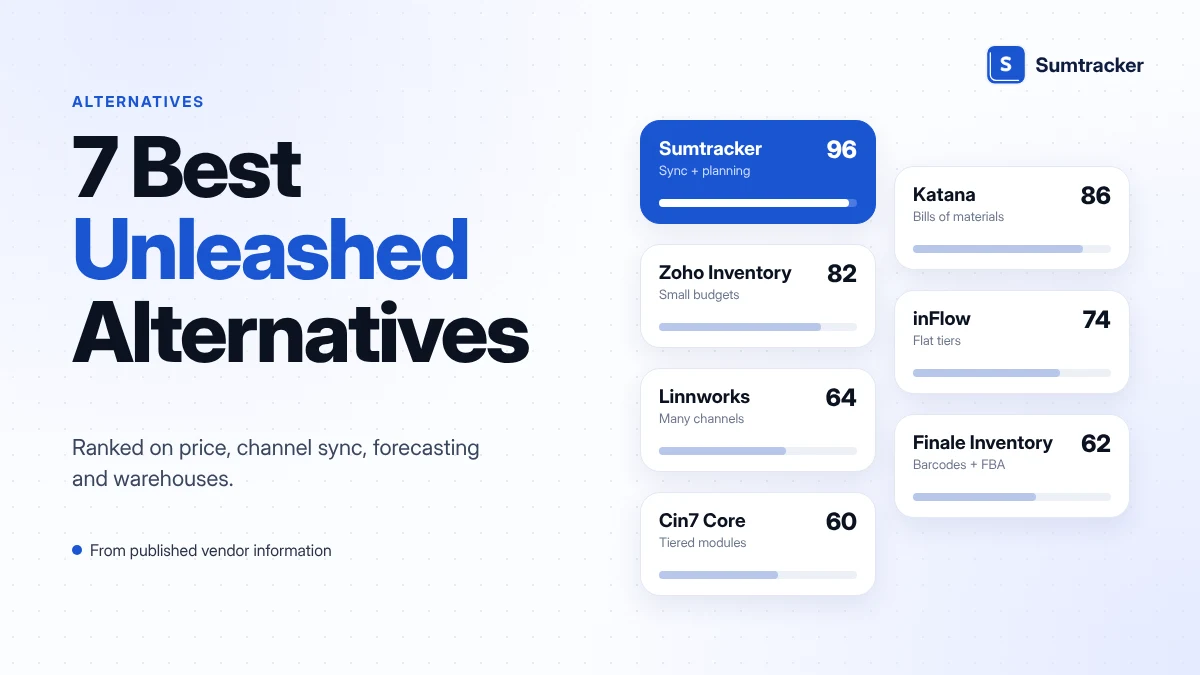
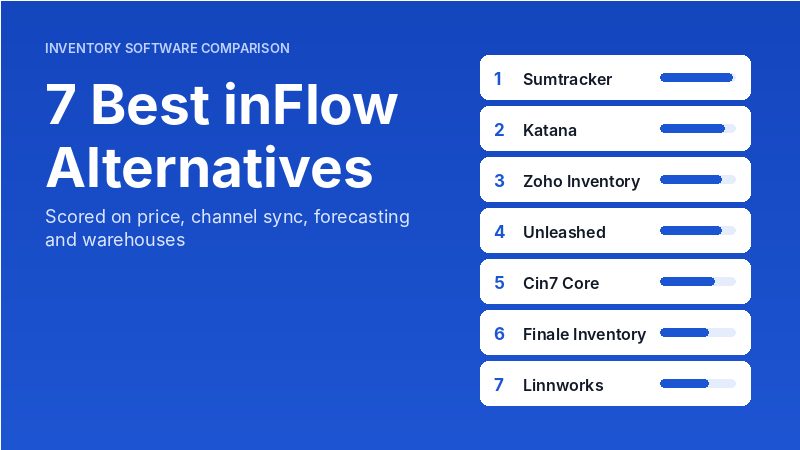
Sumtracker ranks first with 96/100, then Katana at 86. Zoho Inventory and Unleashed tie at 82, and Zoho Inventory ranks higher on the lower published price. inFlow itself scores 86 on the same scale: it earns top marks on price, channels, bundles and transparency, and loses points on forecasting and included locations. These scores reflect our criteria and weights, not overall software quality. The criteria, weights and score definitions are set out in How we ranked these inFlow alternatives, below the tool sections.
Alternatives to inFlow compared: monthly cost for 5 users, 2 locations and 500 orders a month
The same team costs very different amounts across inFlow and its alternatives, because each charges for a different thing: team members, locations, orders or add-ons. The table prices one team of 5 users, 2 locations and about 500 orders a month (6,000 a year), cheapest published price first.
inFlow lists Lite at $99/month, Core at $299, Pro at $499 and Max at $699, all billed annually, with 2, 5, 10 and 20 team members. Prices are in USD, were checked on November 23, 2026 on each vendor's own pages and may change. Where a page did not state a limit, the table says so rather than assuming one.
1. Sumtracker: best for Shopify and multichannel sellers who want stock sync plus reorder planning
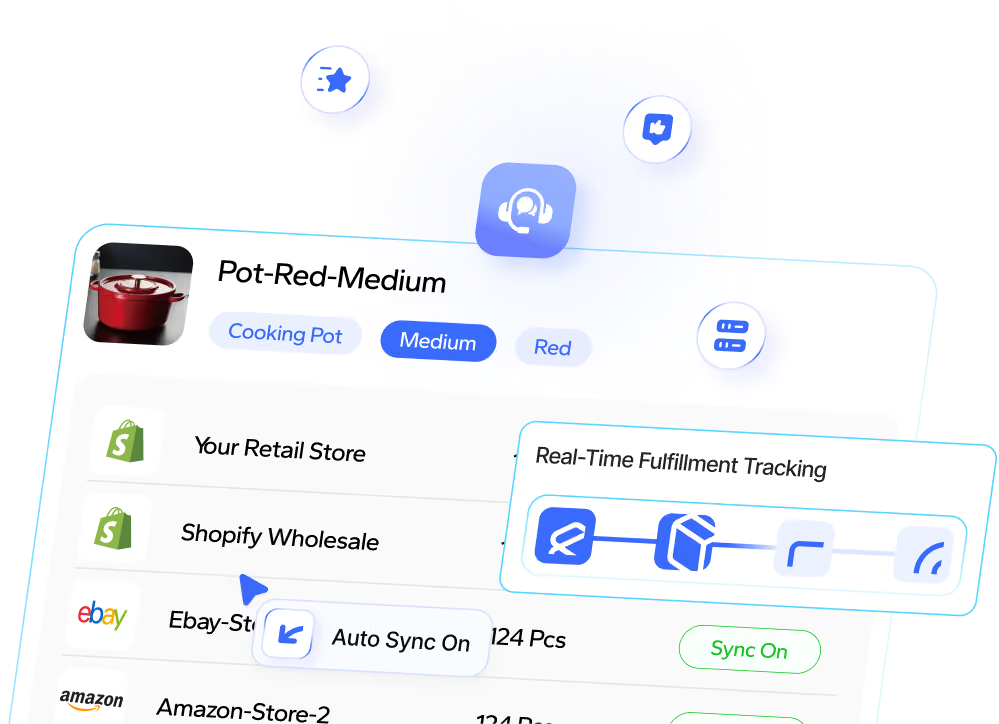
Sumtracker is an inventory management, forecasting and planning platform for Shopify and multichannel brands. It syncs stock across Shopify, Amazon, Walmart, Etsy and eBay and, on its Replenish plan, suggests what to reorder, when and how much.
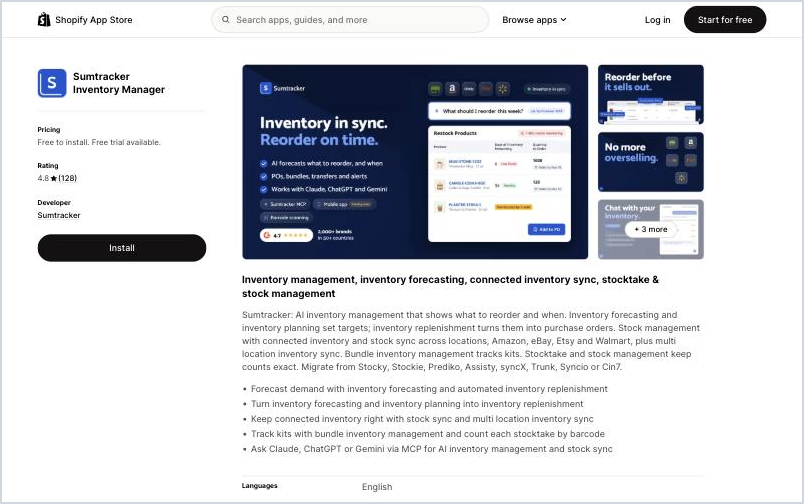
Best for: Shopify and marketplace brands that sell their own or resold stock and want one stock count across channels.
Skip if: you need bills of materials or production planning, batch or lot tracking, pick-pack-ship or bin-level warehouse workflows, or a B2B ordering portal.
Key features:
- Multichannel stock sync: Connects Shopify, Amazon (FBA and FBM), Walmart, Etsy and eBay; inventory is pushed to stores every few minutes per the help center.
- Bundles, stocktake and barcodes: Bundles, inventory adjustments, stocktake, barcode scanning, reports and API access come with the Manage plan.
- Warehouses and channels: Up to 10 warehouses and 10 connected sales channels on standard plans.
- Forecasting and replenishment (Replenish plan): 12-month forecasting, reorder suggestions with a quantity and an order-by date, purchase orders and stock transfers. See how inventory forecasting works.
Pros and cons
Pros
- Priced by annual sales orders, not revenue, with the full tier table published.
- Warehouses and channels are included up to 10 each.
- 14-day free trial with no credit card.
Cons
- Forecasting, reorder suggestions and purchase orders need the Replenish plan.
- No bills of materials, production planning, batch tracking or lot tracking.
- Stock changes must be made inside Sumtracker once sync is on; changes made in the store panel are not detected.
Pricing
Manage is $59/month and Replenish $119/month on monthly billing for up to 5,000 orders a year ($50 and $100 on annual billing). At 6,000 orders a year you fall in the 10,000-order tier: Manage $119/month and Replenish $179/month monthly, or $100 and $150 billed annually. Checked November 23, 2026. 14-day free trial, no credit card.
Why it fits an inFlow switcher: inFlow's pages document reorder points and a Recommended Reorder Point report. Sumtracker's Replenish plan adds forecasting with suggested quantities and order-by dates, plus multichannel sync across Shopify, Amazon, Walmart, Etsy and eBay. At 6,000 orders a year Replenish costs $179/month on monthly billing, against inFlow Core at $299/month billed annually. The two cover different ground, since inFlow adds a B2B portal and a manufacturing add-on that Sumtracker does not.
No single account makes up more than 10% of those orders, so the total reflects hundreds of stores rather than one large customer. About half of those accounts are on Replenish, the plan with forecasting and reorder suggestions, which is the part inFlow's pages do not document.
Who should choose Sumtracker? Choose Sumtracker if you sell through Shopify and marketplaces and want one stock count, sync across channels and reorder planning, and you do not need manufacturing or a B2B portal.
2. Katana: best for product makers who need bills of materials and demand planning
Katana is cloud inventory and manufacturing software for product businesses. It suits makers that sell through Shopify, Amazon and other channels and need bills of materials, bundles built from components and multiple locations in one system.

Best for: Product makers and brands with kits or assemblies.
Skip if: you mostly resell finished goods, want published monthly pricing before talking to sales, or run Amazon or WooCommerce on the free plan.
Key features:
- Bills of materials: Katana handles bundles and kits with bills of materials.
- Demand planning: The Advantage plan lists advanced demand planning and forecasting, replenishment planning and inventory control.
- Locations and users: Unlimited inventory locations on both plans, and unlimited users.
- Channels: Katana's support center documents Shopify, Amazon FBA and FBM, WooCommerce, BigCommerce and eBay integrations.
Pros and cons
Pros
- Free plan available for up to 30 SKUs, with unlimited users and locations.
- Advantage includes a guided implementation, an assigned implementation manager and 24/7 live support.
Cons
- The only paid plan is Advantage, a custom-priced annual contract with no published price.
- The free plan is capped at 30 SKUs after a 15-day unlimited-SKU trial, and only Shopify currently works with it for ecommerce.
Pricing
Free for up to 30 SKUs. Advantage is custom pricing under one annual contract with unlimited SKUs, users and integrations. Katana publishes no monthly price for Advantage as of November 23, 2026.
Why it fits an inFlow switcher: If you use inFlow's manufacturing add-on (from $69/month on Lite to $159/month on Max), Katana is the closest like-for-like because bills of materials sit at the centre of the product. The trade-off is pricing you only learn from sales.
3. Zoho Inventory: best for small sellers on a tight budget
Zoho Inventory is an inventory management platform that connects to Amazon, Etsy, eBay and Shopify. It suits small ecommerce businesses, and teams already on Zoho apps, that need order management, stock tracking and purchase orders at a low monthly cost.

Best for: Small sellers under 500 orders a month, or Zoho users.
Skip if: you need demand forecasting or reorder planning: the pricing page does not document it, and Standard allows two locations.
Key features:
- Syncs orders and stock with Amazon, Etsy, eBay and Shopify.
- Composite items, dropshipment and backordering from the Free plan.
- Multiple locations: 1 on Free, 2 on Standard, 4 on Premium.
- Premium adds serial and batch tracking, barcode generation and stock counting.
Pros and cons
Pros
- Free plan, and a $29/month paid entry price, the lowest paid price in this list.
- Add-ons are priced openly: 500 extra orders, or a user, for $7.50/month each, and a location for $10/month.
Cons
- Forecasting and reorder points are not documented on the pricing page checked.
- Zoho's help page says new items can flow from a marketplace into Zoho Inventory but not the other way round, so catalog changes start in the channel.
Pricing
Free: $0 for 50 orders, 1 user, 1 location. Standard: $29/month for 500 orders a month, 3 users, 2 locations. Premium: $79/month for 3,000 orders, 5 users, 4 locations. USD per organization, billed annually, excluding local taxes; monthly-billed prices are not shown. Checked November 23, 2026.
Why it fits an inFlow switcher: Zoho Standard at $29/month covers 500 orders a month, against inFlow Lite at $99/month billed annually with 2 team members and 1 location. It is the cheapest move, but it gives up inFlow's manufacturing add-on and documented reorder report.
4. Unleashed: best for teams that want costing and optional manufacturing with tiered plans
Unleashed is inventory management software for product businesses that need stock, purchasing, sales orders and optional production in one system. It suits wholesalers and makers that outgrow spreadsheets and accept paying for add-ons.

Best for: Wholesalers and makers that want costing, multi-warehouse and production.
Skip if: you want one low monthly price: users, integrations, order upgrades and add-ons are each charged separately.
Key features:
- Inventory, sales order and purchasing management on every plan.
- Production and Manufacturing add-on at $69/month, free with Pro.
- Advanced Inventory Manager (forecasting and MRP) at $149/month, free with Pro, optional with Core.
- Warehouse management with multi-bin at $149/month, free with Pro; warehouse transfers are not available on Lite.
Pros and cons
Pros
- Plans are published monthly, with a 14-day free trial and no credit card.
- Pro includes forecasting, warehouse management and production, which Core sells separately.
Cons
- Costs rise with extra users ($69/month), extra integrations ($39/month) and order upgrades ($200 to $490/month above 500 orders).
- Cancellation needs 30 days' notice.
Pricing
Lite $99/month (3 users, 100 orders a month). Core usually $399/month (3 users, 500 orders). Pro usually $729/month (5 users, 500 orders). Billed monthly, USD, excluding tax, checked November 23, 2026; a Black Friday offer of 90% off the first three months of Core and Pro runs to November 30, 2026 and is not used in our scoring.
Why it fits an inFlow switcher: Unleashed is the like-for-like for inFlow's costing, purchasing and manufacturing scope. Core at $399/month with 3 users compares with inFlow Core at $299/month billed annually with 5 users, so check which plan sizes match before comparing the headline numbers.
5. Cin7 Core: best for sellers who want assembly, bills of materials and tiers
Cin7 Core is an inventory platform with three published plans and paid modules. It suits growing sellers who want built-in assembly and bills of materials and will add forecasting and warehouse modules as they scale.

Best for: Growing sellers with kits, assemblies and several channels.
Skip if: you want forecasting or advanced warehouse management included: forecasting is an add-on on every plan and advanced warehouse management is an add-on on Pro.
Key features:
- Standard: 5 users, 6,000 sales orders a year and 2 e-commerce and app integrations.
- Pro: 10 users, 24,000 orders a year and 4 integrations; Advanced: 15 users, 120,000 orders a year and 6 integrations.
- Assembly, bills of materials, kits and batch tracking are included on Standard.
- Cin7 ForesightAI forecasting is available as an add-on.
Pros and cons
Pros
- Three plans with published monthly prices and a 14-day free trial.
- Manufacturing basics are included from Standard; MRP is included from Pro.
Cons
- Integrations are capped per plan, so check that your channels fit within two on Standard.
- Standard covers standard warehouse management at one warehouse location, and add-on prices are not listed.
Pricing
Standard $349/month, Pro $599/month and Advanced $1,199/month, in USD excluding tax, for new customers. The page does not say whether billing is annual or monthly. Checked November 23, 2026.
Why it fits an inFlow switcher: Cin7 Core Standard includes assembly and bills of materials in the base price, where inFlow sells manufacturing as an add-on. At $349/month it costs more than inFlow Lite or Core, and it caps integrations at two, so list your channels first.
6. Finale Inventory: best for self-fulfilling brands with multi-warehouse and Amazon workflows
Finale Inventory is inventory and order management software for multichannel operators. It suits brands that fulfil from their own warehouses and want 40-plus sales channel integrations and replenishment workflows included.

Best for: Brands that ship from several warehouses and sell on Amazon and other marketplaces.
Skip if: you want a published price under $499/month, a free trial, or API access without an Enterprise contract.
Key features:
- Multi-warehouse management and 40-plus sales channel integrations on every plan.
- Procurement and replenishment included, with sales velocity forecasting in its features list.
- Amazon order import, FBA shipment sync and FBA replenishment workflows.
- Mobile barcode WMS module included with Growth and Enterprise.
Pros and cons
Pros
- Standard onboarding is included in the subscription.
- Multi-warehouse is included from Essentials.
Cons
- Highest published entry price here: Essentials from $499/month.
- No free trial is mentioned, most customers sign 12-, 24- or 36-month agreements, and API access is listed for Enterprise only.
Pricing
Essentials from $499/month and Growth from $799/month; Enterprise is custom. The page shows monthly prices and does not say how billing works. Overage fees or a plan upgrade may apply above plan limits. Checked November 23, 2026.
Why it fits an inFlow switcher: Finale Inventory includes multi-warehouse and replenishment from its first plan, where inFlow Lite includes one location and Core five. The price is about five times inFlow Lite's $99/month, so it fits only when warehouse workflows are the reason you are leaving.
7. Linnworks: best for high-volume sellers with many sales channels
Linnworks is a multichannel order and inventory platform sold by quote. It suits high-volume sellers that need a wide channel list and accept order-tiered pricing.

Best for: High-volume marketplace sellers with shipping and listing needs.
Skip if: you need published prices or a free trial: neither appears on the pages we read.
Key features:
- 100-plus channel integrations and 70-plus shipping providers and aggregators.
- Open API and accounting integrations including QuickBooks.
- Linnworks Forecasting as a separate flat-fee module.
- SkuVault Core adds quality control, serialization, product substitution and 3PL management, in North America only.
Pros and cons
Pros
- Integrations are described as unlimited and usually free.
- Every package includes a guided onboarding plan.
Cons
- No plan prices, tier thresholds or forecasting fee are published.
- Overage charges apply above your order tier, and onboarding is a separate one-off fee.
Pricing
Quote-based and tiered by monthly orders, with overages above the tier. Linnworks Listing, Linnworks WMS and SkuVault Enhanced Warehouse are also priced by order volume, and Forecasting is a flat fee. The pricing page does not mention a free trial. Checked November 23, 2026.
Why it fits an inFlow switcher: Linnworks has the longest channel list here, which matters if inFlow's direct connectors plus a partner connector no longer cover your marketplaces. You will only learn the price, and the forecasting fee, from a quote.
When inFlow is still the better choice, and where it falls short
- You need manufacturing in the same system. inFlow sells a manufacturing add-on from $69/month on Lite to $159/month on Max, and only inFlow Manufacturing can export bills of materials. Sumtracker has no bills of materials, so makers should compare Katana, Unleashed or Cin7 Core, or stay.
- You rely on direct QuickBooks Online or Xero sync. inFlow's integrations page lists QuickBooks Online, Intuit Enterprise Suite and Xero. Sumtracker's pricing page lists a QuickBooks integration on Replenish and does not mention Xero, so confirm your accounting connection before you move.
- Your order volume is high but your team is small. inFlow includes unlimited products, sales orders and integrations on every plan, so orders never change the tier. A one-warehouse store with two users stays at $99/month on Lite however many orders it ships, while order-tiered tools such as Sumtracker, Zoho Inventory and Unleashed step up as volume grows.
- Where it falls short on add-on cost. Lite includes 2 team members and 1 location; extra members cost $29/month each and extra locations $39/month each. Three extra users and three extra locations add $204/month, which already exceeds the $200 gap to Core at $299/month. Most plans also carry a one-time $499 onboarding fee.
- Where it falls short on forecasting. inFlow's help center documents a Recommended Reorder Point report built from past sales, vendor lead time and a safety-stock percentage you choose, and says to adjust it for seasonality. Demand forecasting is not documented on its site as of November 2026, and the page does not say which plans include the report.
- Where it falls short on channel scope. inFlow connects Shopify, Amazon and WooCommerce directly, while eBay, Walmart and Etsy connect through Extensiv Integration Manager, a partner connector with documented differences from core integrations. Its Shopify page lists order pull, stock and tracking push and multiple stores, and does not mention variants or bundles. A few Shopify App Store reviews, one from February 2023, describe duplicated edits and one-way fulfillment sync; treat them as anecdotal given the small count.
How to switch from inFlow in 5 steps
How we ranked these inFlow alternatives
We scored seven inFlow alternatives against six weighted criteria, using the pricing, feature and help pages each vendor publishes rather than hands-on testing. We fixed the weights before scoring, drawing them from the limits on inFlow's own pages (extra users, locations and add-ons, reorder points instead of forecasting) and the channel-sync themes reviewers raise. Every tool was assessed at about 500 orders a month (6,000 a year) on November 23, 2026.
Each criterion scores 1, 3 or 5. When a vendor's pages did not document a feature or limit, we assigned a neutral 3 and marked it with an asterisk, so an undocumented feature is not treated as missing.
Scoring note: We use a 1/3/5 scale only. Asterisks mark undocumented cases: Katana and Linnworks price, Zoho Inventory forecasting, Cin7 Core and Linnworks warehouses, and Finale Inventory forecasting and bundles. Ties are broken by the higher forecasting score, then the lower published monthly price at 500 orders, with undocumented prices last.
How the ranking changes if you weight criteria differently
Sumtracker ranks first on two of three weightings and Katana first when warehouses and manufacturing carry half the weight. If price alone drove your decision, inFlow itself would be a hard tool to beat, which is why the case for leaving rests on forecasting, included locations and channel scope.
If reorder planning and Shopify and marketplace sync are why you are leaving inFlow, start with Sumtracker and check that you can live without manufacturing and a B2B portal. If you build products, compare Katana and Unleashed first, and if cost is the driver, price Zoho Inventory against inFlow's add-ons at your own user and location count.
Sumtracker ranked first in our scoring at 96 out of 100. It syncs stock across Shopify, Amazon, Walmart, Etsy and eBay, and its Replenish plan adds reorder suggestions. It has no bills of materials, so makers should look at Katana.
Zoho Inventory has the lowest published paid price at $29 per month billed annually, covering 500 orders a month and two locations, plus a free plan for 50 orders. It does not document demand forecasting on its pricing page.
Zoho Inventory offers a free plan for 50 orders a month, one user and one location. Katana offers a free plan for up to 30 SKUs. Both free plans are capped, so check order or SKU volume before moving.
Katana is built around bills of materials and production planning, and Unleashed offers a Production and Manufacturing add-on at $69 per month. Cin7 Core includes assembly and bills of materials on its Standard plan. Sumtracker does not offer bills of materials.
Common reasons are costs that rise with extra team members, locations and add-ons, reorder points instead of documented demand forecasting, and limited channel scope beyond Shopify and Amazon. If manufacturing or a B2B portal matters, inFlow may still be the better fit.
The main inFlow competitors in our scoring are Sumtracker, Katana, Zoho Inventory, Unleashed, Cin7 Core, Finale Inventory and Linnworks. Apps like inFlow that include manufacturing are Katana, Unleashed and Cin7 Core; the others focus on multichannel selling.
Yes. inFlow's integrations page lists direct connections to QuickBooks Online, Intuit Enterprise Suite and Xero. We did not score accounting sync, so confirm that any inFlow alternative supports your accounting software before you move.