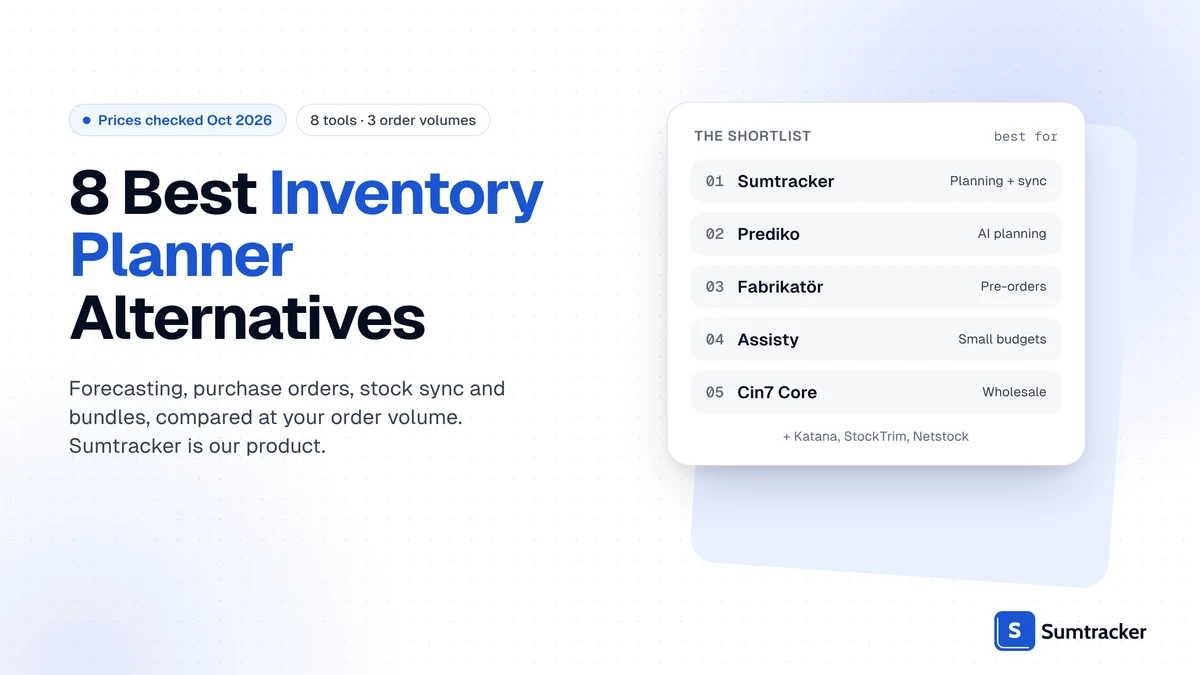


Inventory Planner by Sage is a forecasting and purchase planning tool for ecommerce brands. Its forecasts account for seasonality, trends and stockout days, and merchants credit it with turning hours of spreadsheet purchasing into minutes a week.
But it is a planning tool rather than an inventory management system, so many merchants pair it with another system for stock sync, and its standard plans are priced by quote. If you're weighing the quote against what you get, here are the 8 best Inventory Planner alternatives.
Disclosure: Sumtracker is our product. We evaluated it alongside the other tools using the same criteria: published features, published pricing and public reviews.
Where Inventory Planner Falls Short
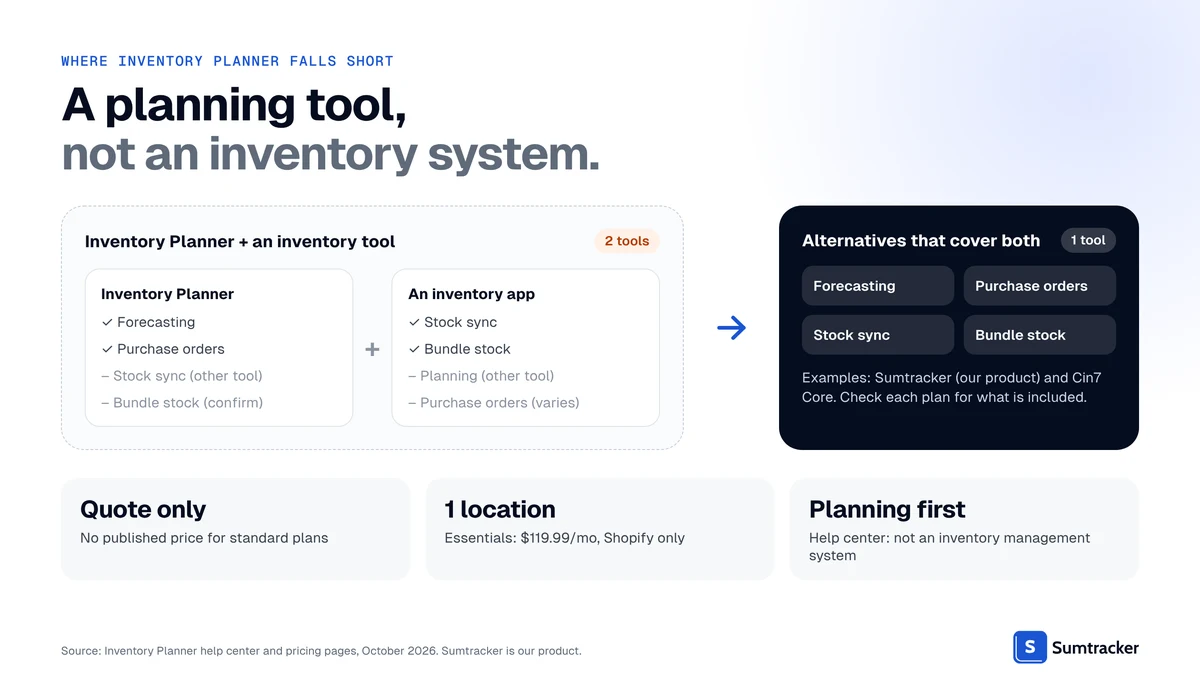
- Its help center describes it as not an inventory management system, so merchants who need stock sync across channels usually run another tool alongside it
- Bundle support is built around planning; if you need component stock deducted on every sale, confirm how it works for your setup
- Standard plans aren't published and are quoted by inventory volume
- The Essentials plan is listed at $119.99/month for one location and connects to Shopify only
- A 2026 Capterra reviewer calls the price "on the high side"
It's still the better pick if you want open-to-buy planning, already run an IMS or ERP that handles stock, or rely on forecasting settings you spent weeks tuning. If not, here's how the alternatives compare.
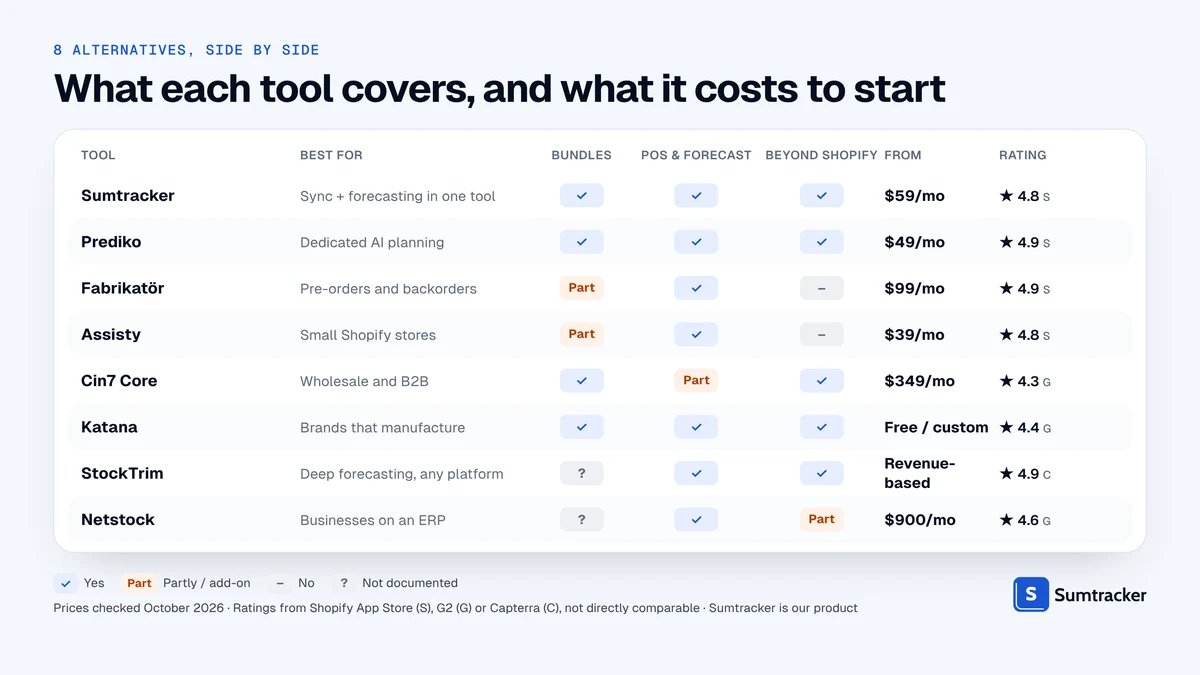
Prices checked on each vendor's pricing page in October 2026 and may change. Sumtracker is our product; we list its limits the same way we list everyone else's.
How We Evaluated These Alternatives
We picked tools that a merchant using Inventory Planner could realistically move to, across the main situations: Shopify and multichannel stores, wholesale, manufacturing, and ERP-based businesses. Every tool was judged on the same points, and Sumtracker was held to the same rules as the others.
- What we compared: demand forecasting, purchase orders, stock sync across channels, bundles and kits, platform fit, and how the price is set.
- Where the facts come from: each vendor's own pricing page, product pages and help documentation, checked in October 2026.
- How we treat gaps: if a vendor doesn't publish a feature or a price, we say so instead of guessing, and we separate a missing native feature from one available through an integration or add-on.
- Ratings: taken from the Shopify App Store for Shopify apps, G2 for broader systems and Capterra for StockTrim.
- Every tool gets the same sections: features, pros, cons, pricing, who it suits, and who should skip it.
1. Sumtracker
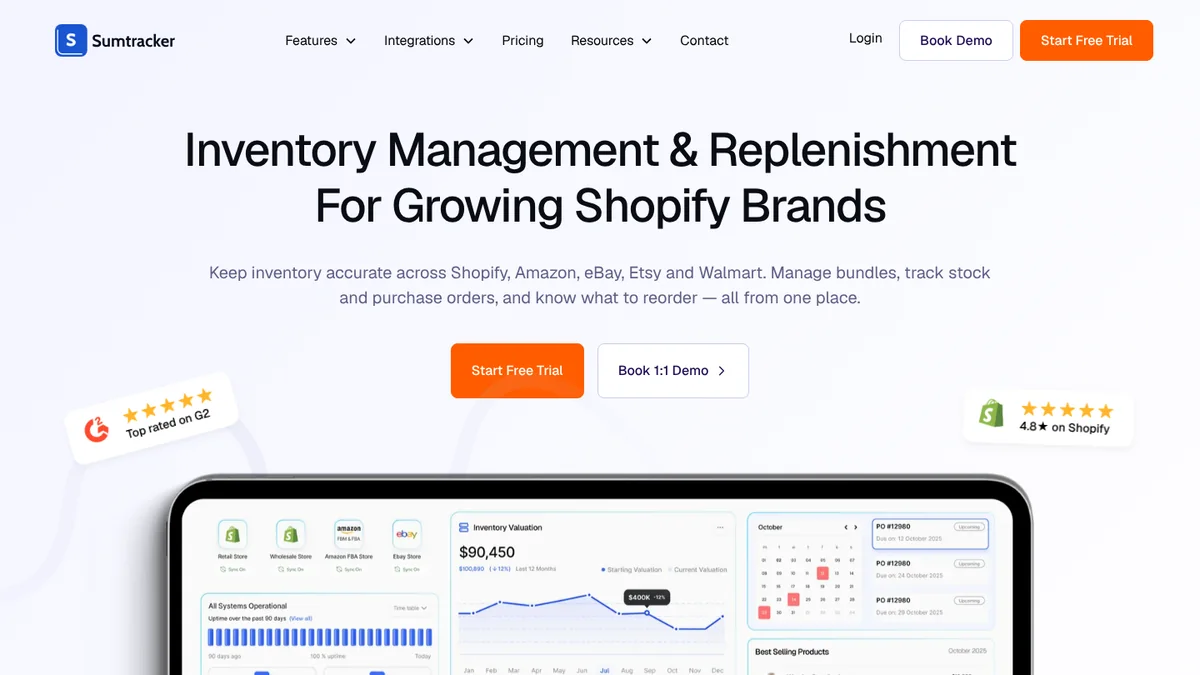
Sumtracker is inventory management and replenishment software for Shopify and Amazon merchants, and it is our product. Your forecast, purchase orders and stock levels live in one place.
It suits multichannel sellers who want one subscription instead of a planner plus an inventory tool.
Key Features:
- 12-month demand forecasting with reorder suggestions
- Purchase orders emailed to suppliers, with partial receiving
- Stock sync across Shopify, Amazon, Walmart, Etsy and eBay
- Bundles and kits that deduct component stock on every sale
- Stock transfers, landed cost and QuickBooks Online
Pros:
- Replaces a planning tool and an inventory tool with one subscription
- Published prices set by annual orders, not revenue or seats
- Free onboarding on every plan
Cons:
- Forecasting and POs need the Replenish plan; the $59 Manage plan covers sync and bundles only
- No shipping labels, manufacturing or BOMs, and no batch or lot tracking
Pricing: Starts at $59/month (Manage plan); purchase orders and forecasting from $119/month (Replenish plan). 14-day free trial. Rated 4.8 from 127 reviews on the Shopify App Store.
Why It's a Better Inventory Planner Alternative: It covers planning and also stock sync and bundle stock in one tool, which suits merchants who would otherwise run two. See the Sumtracker vs Inventory Planner comparison.
Skip if: You only need a planning layer on top of an ERP or WMS you're keeping.
2. Prediko
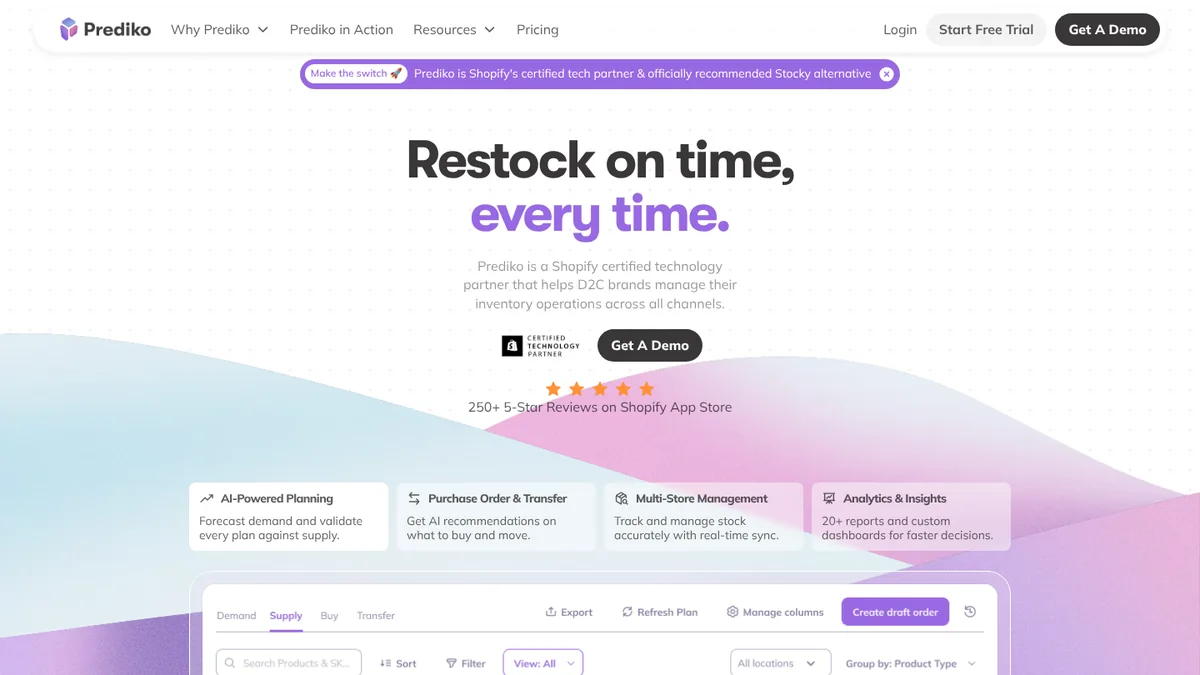
Prediko is a forecasting and purchasing app for Shopify brands, with an AI planning agent and every feature on every tier.
It's the closest like-for-like swap for Inventory Planner on Shopify.
Key Features:
- AI demand forecasting and a supply planner
- Unlimited purchase orders and inventory alerts
- 20+ customizable inventory reports
- Multi-store and multi-location planning, plus bundles
Pros:
- Published prices and a self-serve 14-day trial
- Unlimited users and SKUs on every plan
Cons:
- Price climbs with revenue, so high-AOV brands pay more for the same order count
- Built around Shopify; Amazon, Etsy and Faire are available as integrations
Pricing: From $49/month for stores under $100K annual GMV, $119 up to $500K, $199 up to $2M; custom above that. Rated 4.9 from 264 reviews on the Shopify App Store.
Why It's a Better Inventory Planner Alternative: Similar planning depth, with prices you can see before a sales call. See how it compares with Sumtracker.
Skip if: Most of your orders come from Amazon or Walmart rather than Shopify.
3. Fabrikatör
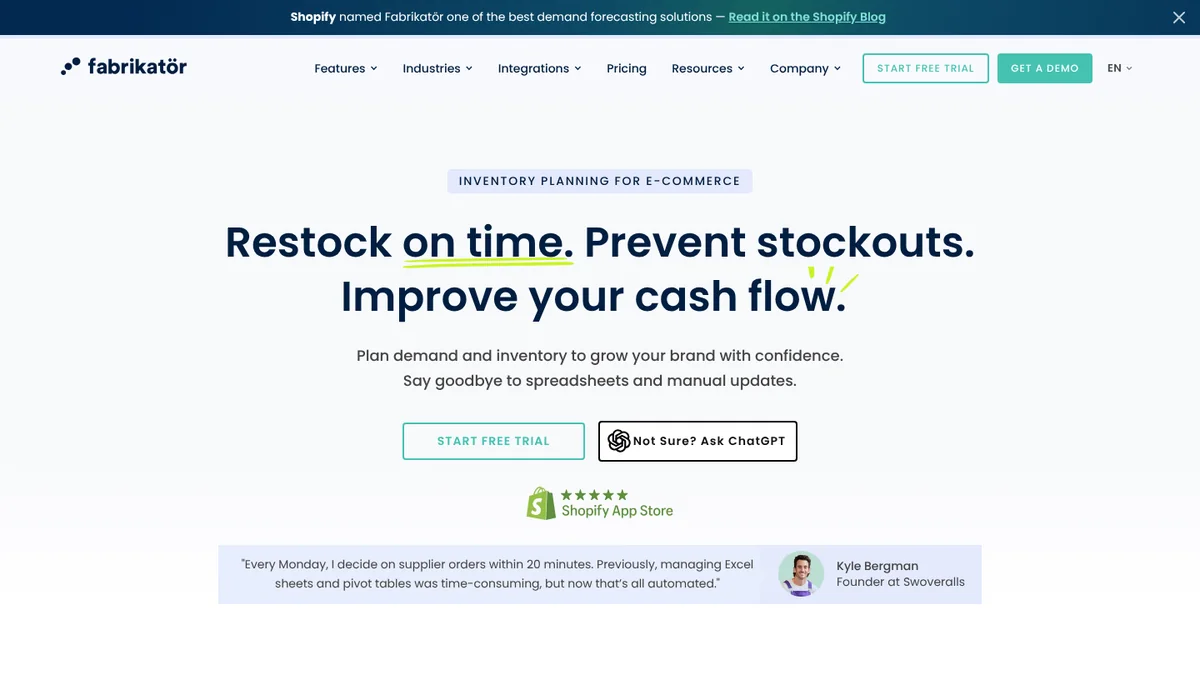
Fabrikatör forecasts demand and plans purchases for Shopify stores, and it also runs pre-orders and backorders while stock is on the way.
It suits brands that want to keep selling while a PO is in transit.
Key Features:
- Demand forecasting and replenishment suggestions
- Purchase orders and bundle planning
- Backorders and pre-orders tied to incoming stock
- Inventory reports, with unlimited SKUs and users
Pros:
- Keeps selling while you wait for a PO to land
- Priced per store, not per seat
Cons:
- Shopify only
- Each backorder after the first 50 costs $0.75
- Its pricing page and Shopify listing show different tiers, so confirm current pricing before you buy
Pricing: Its pricing page FAQ lists $99/month under $50K monthly sales, $149 for $50K–$200K and $350 for $200K–$400K. Its Shopify App Store listing shows $99, $149 and $199 by annual revenue (up to $500K, $1.5M and $2.5M), and its pricing-page calculator shows $79/month for stores up to $500K. Rated 4.9 from 76 reviews on the Shopify App Store.
Why It's a Better Inventory Planner Alternative: You keep the forecasting and POs, and add a way to take orders on items you've already reordered. Our Fabrikatör alternatives guide covers its limits.
Skip if: You sell on Amazon or other marketplaces.
4. Assisty
Assisty is a Shopify inventory app that starts free for reporting and adds forecasting and purchasing on its paid plans.
It suits small Shopify stores on a tight budget.

Key Features:
- Sales and stock reports on the free plan
- Seasonal, trend and bundle demand forecasting
- Smart buying table, purchase orders and receiving
- Transfer suggestions and stocktakes
Pros:
- The lowest entry price on this list
- A free plan to try the reporting first
Cons:
- Shopify only
- The price is set by your Shopify plan, not by how much of the tool you use
Pricing: The Replenishment plan with POs costs $39/month to $199/month depending on your Shopify plan; forecasting alone starts at $19. Rated 4.8 from 359 reviews on the Shopify App Store.
Why It's a Better Inventory Planner Alternative: On lower Shopify plans it costs less than Inventory Planner Essentials and adds stocktakes and transfers.
Skip if: You sell on Amazon, eBay or Etsy as well.
5. Cin7 Core
Cin7 Core is a full inventory and order management system, so it replaces both Inventory Planner and the tool you run stock in, with a B2B portal on top.
It suits brands that sell wholesale alongside ecommerce.
Key Features:
- Purchasing, sales orders and multi-location stock
- B2B portal and POS
- Bill of materials and assemblies
- ForesightAI forecasting with reorder automation (add-on)
Pros:
- One system for wholesale and DTC
- Hundreds of integrations
Cons:
- Forecasting is an add-on with no published price
- User and order caps on every Core plan
Pricing: From $349/month (Standard, 6,000 sale orders a year, 5 users); Pro $599 and Advanced $1,199. Rated 4.3 from 351 reviews on G2.
Why It's a Better Inventory Planner Alternative: It runs the stock, orders and wholesale side that Inventory Planner only reads from. See Sumtracker vs Cin7.
Skip if: You're a DTC brand that only needs forecasting and POs.
6. Katana Cloud Inventory
Katana Cloud Inventory is manufacturing and inventory software. It plans what to make and what to buy, which a pure planning tool can't.
It suits brands that make their own products.
Key Features:
- Manufacturing orders and bills of materials
- Raw material and finished goods planning
- Purchase orders, kits and bundles
- Shop floor app for production teams
Pros:
- Ties sales demand to production and raw materials
- Free plan for small catalogs
Cons:
- Paid plan is custom-priced on an annual contract
- The free plan stops at 30 SKUs
Pricing: Free for up to 30 SKUs; the Advantage plan is custom pricing. Rated 4.4 from 128 reviews on G2.
Why It's a Better Inventory Planner Alternative: Inventory Planner forecasts finished goods; Katana also plans the raw materials and production runs behind them. Compare it in our Katana alternatives guide.
Skip if: You resell finished goods and don't manufacture.
7. StockTrim
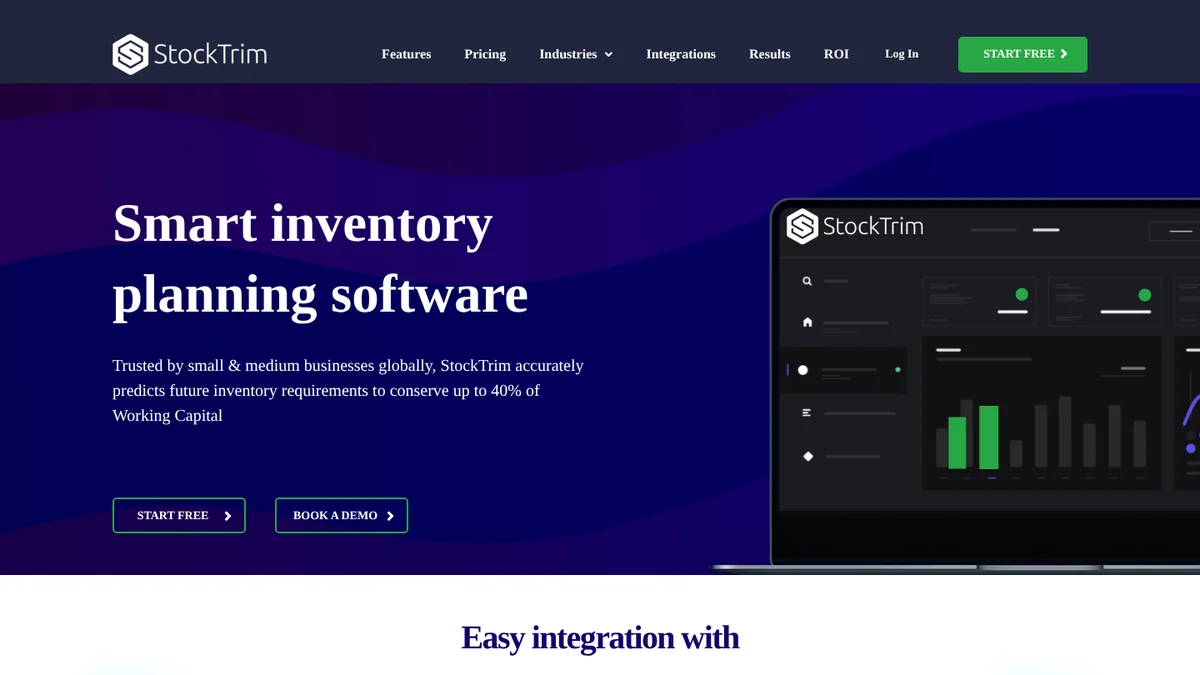
StockTrim is demand forecasting and inventory planning software for small and mid-sized businesses. It uses machine learning to forecast demand and turns the forecast into order plans and purchase orders.
It suits brands, wholesalers and manufacturers that want deeper forecasting and plan to keep stock in their existing system.
Key Features:
- Machine-learning forecasting with automatic seasonality
- Order plans and reorder schedules based on lead times
- Forecasts for new products without sales history
- Multi-location planning and automated purchasing workflows
- Raw materials forecasting and multi-level BOMs (add-on)
Pros:
- Unlimited users and SKUs on every plan
- Works with Shopify, WooCommerce, Amazon FBA, QuickBooks and others, plus an API
- Onboarding session and a customer success manager included
Cons:
- Prices appear only in its revenue-based calculator
- It plans purchases but doesn't hold stock, and its site doesn't mention bundles
- Its pricing page lists a $299 onboarding fee while its FAQ cites a $497 package
Pricing: Priced by annual revenue in 12 bands from under $100K to $50M+; its site shows $298/month billed annually at $3M–$5M. Raw materials forecasting and multi-level BOMs add $90/month. 14-day free trial, no card. Rated 4.9 from 14 reviews on Capterra.
Why It's a Better Inventory Planner Alternative: It matches Inventory Planner's focus on forecasting and adds forecasts for new products and component demand, on any platform it connects to.
Skip if: You want stock sync and bundles in the same tool, or a price you can see up front.
8. Netstock
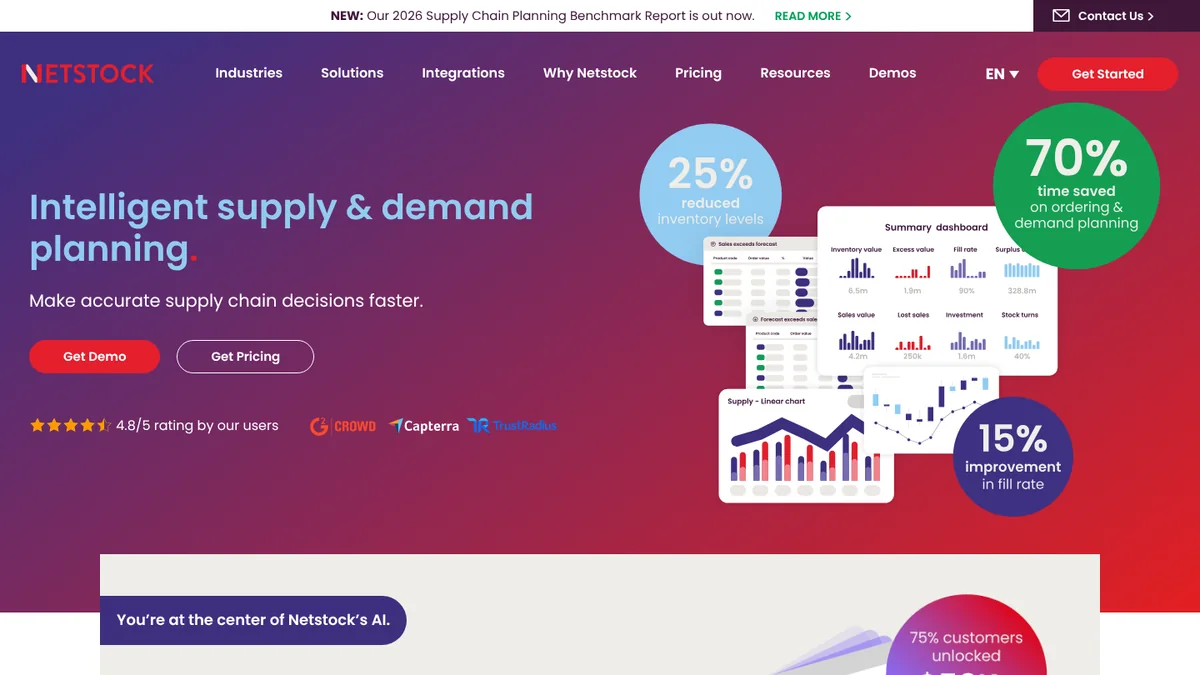
Netstock is planning software that sits on top of an ERP, turning ERP data into forecasts, order plans and supplier performance reports.
It suits businesses whose source of truth is an ERP rather than Shopify.
Key Features:
- Demand forecasting and inventory optimization
- Order planning and supplier performance
- Sales and operations planning
- Connections to 60+ ERPs, including NetSuite, Sage, Acumatica and Dynamics
Pros:
- Deep planning built for ERP data
- Large, long-running review base
Cons:
- Needs an ERP; no direct Shopify connection is listed
- Annual contract; implementation takes longer than self-serve tools
Pricing: From $900/month on an annual subscription. Rated 4.6 from 181 reviews on G2.
Why It's a Better Inventory Planner Alternative: If your system of record is an ERP, Netstock is built for that data.
Skip if: You run on Shopify or Amazon without an ERP.
What Each Alternative Costs as per Yearly Orders
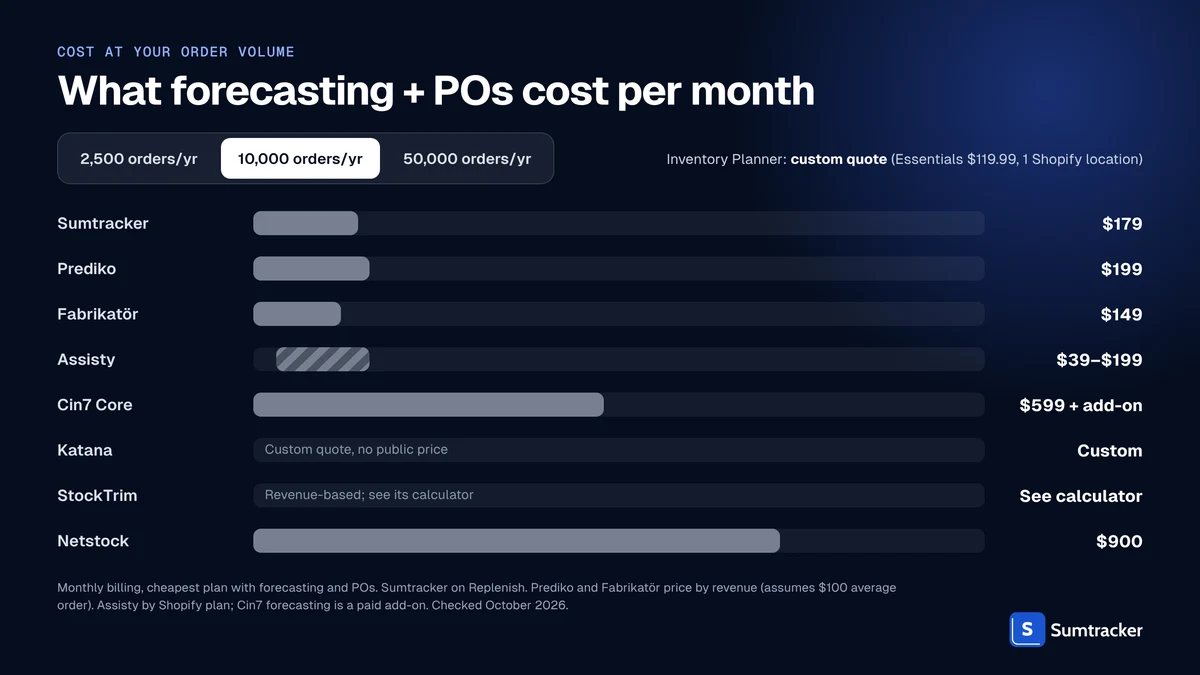
Monthly price on monthly billing, for the cheapest plan with forecasting and purchase orders. Figures read 2,500 / 10,000 / 50,000 orders a year.
Prediko and Fabrikatör price by revenue, so we assumed a $100 average order value ($250K, $1M and $5M a year). Fabrikatör's pricing page lists $99 under $50K monthly sales, $149 for $50K–$200K and $350 for $200K–$400K; at our three volumes that gives the figures above. Cin7 Core doesn't publish its forecasting add-on price, StockTrim shows prices only in its calculator, and Netstock lists a starting price only.
Best Inventory Planner Alternative for Your Situation
There isn't one best tool for everyone. Find your situation below, and check the last column before you shortlist.
Conclusion
Inventory Planner is a strong forecasting tool, but it is a planning layer rather than an inventory management system, and its standard plans are quote-based.
If you're paying for a planner plus a separate inventory tool, it's worth pricing a combined tool. If you only need a planner, pick by where you sell and where your data lives.
To switch, export the replenishment and purchase order reports from Inventory Planner as CSVs where available, record your forecast settings manually, then run the new tool alongside it for one purchasing cycle before you cancel.
If Sumtracker fits your setup, you can start a 14-day free trial. It is an inventory management tool for Shopify and multichannel sellers that combines forecasting, purchase orders, stock sync and bundles.
It depends on where you sell and what you want to replace. Sumtracker (our product) and Cin7 Core combine planning with stock sync, Prediko and Fabrikatör are dedicated planners for Shopify brands, and Netstock suits businesses that run an ERP.
Common reasons include wanting stock sync and bundle stock in the same tool, published prices instead of a quote, or a plan that covers more than the one-location Essentials plan. Inventory Planner describes itself as a planning tool rather than an inventory management system.
Compare supported sales channels, whether stock sync and bundles are included, forecasting and purchase order features, price at your order volume, setup time, and integrations such as QuickBooks.
Inventory Planner focuses on forecasting and purchase planning. Sumtracker (our product) combines forecasting and purchase orders on its Replenish plan, from $119/month, with multichannel stock sync and bundles. Confirm current features and pricing with each vendor.
Inventory Planner Essentials is Sage's entry-level version of Inventory Planner for small Shopify stores. It costs $119.99/month for one inventory location, connects only to Shopify, uses a single forecasting method and includes purchase orders and vendor management.