.svg)
![10 Best Inventory Management Software for Shopify [Expert's Tested] - Updated 2026](https://cdn.prod.website-files.com/67907f49647e48895e5dc266/699ef477d7260e2a544f9607_Growth%20Unlocked%20with%20Sumtracker%20-%202026-02-25T183855.057.avif)
10 Best Inventory Management Software for Shopify [Expert's Tested] - Updated 2026


- We tested 10 Shopify inventory tools on a live store. Scores ranged from 58/100 to 94/100.
- Sumtracker is the best overall (94/100). It keeps inventory in sync in a single dashboard and covers bundles, forecasting, purchase orders and reporting, from $59/month.
- For simple purchase orders, Fabrikatör scored 88/100. Zoho Inventory is the best free option, but caps out at 50 orders a month.
- Pick a niche tool for niche needs: Veeqo for shipping, Katana for manufacturers, Cin7 or Extensiv for ERP-level operations.
- Accuracy and workflow made up 65 of the 100 points. Speed counted for just 5.
Are you searching for an inventory management software for your Shopify store?
Well, I got you!
I have tested 10 of the most talked-about tools to see which ones will suit you best.
If you are using Shopify’s built-in inventory tool, then it won’t get you far.
Once you start scaling and selling across multiple channels, managing purchase orders, or trying to forecast demand, the native admin just isn’t enough.
It literally doesn’t even cover the basic features well.
At some point, every growing Shopify store needs a proper inventory management system.
The problem is that the market is flooded with options.
I installed each one on a live Shopify store and scored them on what actually matters, which is accuracy, workflow, features, and value for money.
The results?
Scores ranged from 58/100 to 94/100. And picking the wrong tool will cost you more in stockouts, overselling, and manual admin than the software itself ever would.
Key Findings From Our Testing:
- Massive quality gap; scores ranged from 58/100 to 94/100
- Multi-channel sync and bundle support separate good tools from great ones
- The best overall option (Sumtracker) costs less than most tools that do half as much.
- Several tools on this list are genuinely too complex and expensive for most Shopify merchants.
New to Shopify inventory software?
Think of Shopify’s native admin like a basic notepad; it helps you count what you have, but it can’t tell you when to reorder, sync across channels, track bundles, or generate purchase orders automatically.
The tools below are the full system: the forecasting engine, the PO workflow, the multi-channel sync, and the reporting layer.
The problem is that not all inventory tools are built for Shopify merchants specifically.
Some tools are built for warehouses, manufacturers, and legacy ERP systems with a Shopify connector added years later.
Knowing which category actually fits your store saves a lot of wasted trial periods and painful migrations.
Quick Results: Our Top Picks
Best Overall: Sumtracker (94/100) — multi-channel sync, bundle automation, inventory replenishment, forecasting, and deep reporting. Starting at $59/month.
Best Lightweight ERP: Cin7 (69/100) — 700+ integrations and deep operational features for merchants who’ve genuinely outgrown everything else.
Best for High-Volume Warehouses: Finale Inventory (62/100) — barcode-driven accuracy and multi-warehouse control for complex warehouse operations.
Best for Enterprise Scale: Extensiv (58/100) — built for high-volume multichannel brands that have outgrown every other tool on this list.
How We Tested These Tools
I tested each tool by installing it on a live Shopify store running a real product catalogue with fast-moving SKUs, seasonal products, bundles, and slow-moving stock across multiple categories. Data was cleaned before connecting each app, so conditions were consistent across all ten tools.
What I looked for:
- How accurate were the reorder and replenishment recommendations?
- How long did onboarding and setup take?
- Did the multi-channel sync actually work in real time?
- Was bundle tracking automatic or still manual?
- Was there a complete workflow for each feature, or did it stop at the dashboard?
My scoring system weights the important stuff:
- Accuracy and replenishment quality get the highest weight. Wrong recommendations cost real money.
- Workflow integration is heavily weighted. A tool that surfaces data but leaves you to act on it manually is only half a tool.
- Feature completeness matters — multi-channel sync, bundle support, reporting depth.
- Ease of setup matters somewhat. A painful onboarding is a red flag for what support will look like later.
- Speed matters least. Accurate beats fast every time.
How I Calculated Final Scores
Each tool gets scored across five categories, then added up:
- Example — Sumtracker: Accuracy (36/40) + Workflow Integration (24/25) + Feature Completeness (20/20) + Ease of Setup (9/10) + Speed (5/5) = 94/100
- Example — Extensiv: Accuracy (22/40) + Workflow Integration (16/25) + Feature Completeness (13/20) + Ease of Setup (4/10) + Speed (3/5) = 58/100
Accuracy and workflow account for 65 of the 100 points. Speed accounts for 5. That’s intentional.
1. Sumtracker — Best Overall Shopify Inventory Management Software
If you’re looking for inventory management software that combines inventory tracking, replenishment planning, purchasing, and forecasting in one platform, Sumtracker is one of the strongest options available for Shopify merchants.
Many inventory tools focus on only one part of the inventory workflow. Some excel at inventory synchronization, while others specialize in forecasting or purchase order management.
Sumtracker brings these capabilities together, helping merchants manage inventory from day-to-day stock tracking all the way through forecasting future demand and planning replenishment.
.avif)
During our evaluation, Sumtracker stood out for its ability to help merchants make better inventory decisions, not just track inventory.
Features like demand forecasting, replenishment recommendations, purchase order management, and inventory reporting make it particularly useful for growing Shopify brands that need to stay ahead of stockouts and excess inventory.
Whether you’re managing a single Shopify store or selling across multiple channels and locations, Sumtracker provides a centralized system for inventory planning and control.
Key Features
- Real-time multichannel inventory sync
- Inventory replenishment and forecasting
- Automated purchase orders with lead time tracking
- Low stock alerts with configurable reorder thresholds
- Inventory logs, COGS, stock valuation, and other reports
- Multi-location support
- Bulk import/export for all functions
- API access for custom integrations
My Testing Results
The first feature that I tested was multi-channel inventory sync. I connected Shopify, Amazon, and eBay. Right after connecting, every channel’s stock levels were visible from a single dashboard.
Then I set up a bundle. There were three components of one finished product. Ran test orders through and watched every component’s stock deduct automatically and accurately with every sale. This is the thing most inventory tools say they handle and don’t, but Sumtracker handles it properly.
The replenishment planning is where it gets genuinely impressive. Rather than asking you to set arbitrary reorder points and hope they stay relevant, Sumtracker builds a replenishment plan across your entire catalogue based on how fast each SKU is actually selling and how long your suppliers take to deliver.
The result is a prioritised list of what needs ordering, in what quantities, right now, before anything runs out. I tested this against a catalogue with a mix of fast-moving and slow-moving SKUs, and the recommendations were accurate across the board.
The purchase order workflow was clean. Replenishment suggestions surface, one click creates a draft PO, supplier details pull in automatically, and send. Partial deliveries can be received against the same PO and stock updates as each delivery arrives.
The reporting depth also stood out. COGS tracking, stock valuation, days of inventory remaining, full movement logs, all available without any custom configuration.
Most Shopify merchants have never had this level of financial visibility into their inventory. Sumtracker makes it the default.
User Experience
Clean UI. Onboarding is straightforward, and customer support is notably responsive.
Pros & Cons
Strengths: Best multi-channel sync tested, seamless bundle automation, smart replenishment and forecasting, proper PO workflow, deep reporting, and order volume-based pricing.
Weaknesses: No free plan.
Final Verdict
Score: 94/100
The most complete Shopify inventory management tool available. Real-time sync, bundle automation, replenishment, forecasting, POs, and deep reporting — all in one tool, starting at $59/month.
Best for: Any Shopify merchant who has outgrown native admin inventory and needs a proper system that actually runs their stock operations.
Skip if: You are looking for a warehouse management solution, as Sumtracker doesn’t provide features like bills of material or serial number tracking.
👉 Start your free trial of Sumtracker
2. Extensiv — Best for Enterprise Scale
Extensiv is built for high-volume multichannel brands that have genuinely outgrown everything else. It connects inventory, purchasing, and fulfillment in one platform with detailed analytics, designed specifically for fast-scaling operations with large SKU catalogues and high order volumes.
.avif)
Key features:
- Unified multichannel inventory and order management
- Fulfillment automation
- Detailed operational analytics
- High-volume SKU management
- From $399/month
My Testing Results
Extensiv is genuinely powerful for the use case it’s built for. High-volume, multichannel, complex fulfillment operations run cleanly through it. The analytics depth goes further than most tools on this list.
The only problem Shopify merchants can go through is that this tool can be too much. I found the onboarding complex, the pricing is enterprise-level, and the features that justify the cost only make sense at a significant operational scale. For a growing Shopify store that hasn’t hit that ceiling yet, there are better-value options.
Pros & Cons
Strengths: Handles genuine enterprise-level volume, strong fulfillment automation, and detailed analytics.
Weaknesses: Complex onboarding, high price point, overkill for most Shopify merchants.
Final Verdict
Score: 58/100
The right tool at enterprise scale. The wrong tool for everyone else.
Best for: High-volume Shopify brands managing large SKU catalogues with complex multichannel fulfillment requirements.
Skip if: You’re not yet at enterprise scale — the cost and complexity won’t pay off.
3. Zoho Inventory — Best Free Option
Zoho Inventory is the most capable free inventory tool we tested. It handles order management, multi-channel sync, barcode scanning, and bundle tracking, and if you’re already in the Zoho ecosystem (CRM, Books, Analytics), the integrations run deep.
.avif)
Key features:
- Multi-channel sync across Shopify, Amazon, eBay
- Bundle and composite item tracking
- Purchase order management
- Barcode scanning
My Testing Results
From a price point of view, particularly the free tier, Zoho Inventory delivers more than most merchants expect. The composite item tracking handles bundles correctly, and the purchase order workflow covers the basics without overcomplicating things.
The free plan’s 50-order cap is enough to evaluate the tool, but not to run a real business. The Shopify integration works, but it isn’t as tight or as real-time as dedicated tools. The UI requires too many clicks for common tasks, and this can come across as frustrating for many users.
Outside the Zoho ecosystem, the value proposition also weakens considerably. If you’re not using Zoho CRM or Zoho Books, you’re getting a capable but generic inventory tool at a competitive price point.
Pros & Cons
Strengths: Best free plan tested, handles bundles, solid Zoho ecosystem integration, and affordable paid tiers.
Weaknesses: The free plan is too limited for real use, UI is clunky at volume, and Shopify sync is less real-time than dedicated tools.
Final Verdict
Score: 74/100
The right starting point if you want to test an inventory system before committing to the budget. Outgrows quickly, but is genuinely useful early on.
Best for: Small Shopify stores already in the Zoho ecosystem, or merchants who want to evaluate an inventory tool before paying for one.
Skip if: You’re past 50 orders a month or need real-time Shopify sync.
4. Fabrikatör — Best for Simple PO Workflows
Fabrikatör is built around making purchase orders simple. AI forecasting, one-click PO creation, component-level bundle tracking, and a backorder engine that lets you keep selling through stockouts rather than turning customers away.
.avif)
Key features:
- SKU-level AI demand forecasting
- One-click PO automation
- Component-level bundle inventory
- Multi-warehouse stock transfers
- Backorder and pre-order engine
- Klaviyo, QuickBooks, Xero, ShipHero integrations
My Testing Results
The PO creation workflow is the cleanest of any tool tested. A flagged forecast becomes a submitted purchase order in under three minutes. For merchants who find inventory planning overwhelming, that simplicity is genuinely valuable.
The backorder engine is something no other tool here offers; you can keep selling a product after it hits zero and fulfil when stock arrives, without any manual workaround.
Where it falls behind Sumtracker is in overall feature depth and price. $99/month for a narrower feature set is harder to justify when Sumtracker covers more ground at $59/month.
Pros & Cons
Strengths: Cleanest PO workflow tested, backorder engine, solid AI forecasting, good integrations.
Weaknesses: Higher price than Sumtracker, no free plan, narrower feature set.
Final Verdict
Score: 88/100
Strong tool that does what it promises. Best for merchants whose main pain point is purchase order management and who want simplicity over breadth.
Best for: Shopify merchants who want clean, simple PO automation without the overhead of a full inventory platform.
Skip if: Multi-channel sync, deep reporting, or bundle automation are what you actually need.
5. Veeqo — Best for Multi-Channel Shipping
Veeqo is free. It combines multi-channel inventory sync with shipping tools, giving merchants inventory management and carrier rate shopping under one roof at no cost.
.avif)
Key features:
- Free multi-channel inventory sync
- Shipping tools with carrier rate shopping
- Centralised order management across channels
- Basic inventory reporting
- Completely free
My Testing Results
The free pricing is the headline, and it’s genuine. Veeqo is actually free to use. For merchants who sell on Shopify and Amazon together and need basic inventory sync alongside shipping management, it’s a compelling option that costs nothing.
The inventory management depth is limited, though. No bundle support, no demand forecasting, no advanced reporting. And the Amazon ownership means your inventory data sits on Amazon’s infrastructure — worth considering depending on your relationship with the platform.
Pros & Cons
Strengths: Completely free, solid multi-channel sync, shipping tools built in, easy setup.
Weaknesses: No bundle tracking, no forecasting, limited reporting, data sits with Amazon.
Final Verdict
Score: 71/100
Hard to argue with free. But it’s a sync and shipping tool, not a full inventory management system.
Best for: Shopify merchants selling on Amazon who want basic channel sync and shipping tools at zero cost.
Skip if: You need bundle tracking, demand forecasting, or any reporting depth beyond basic stock counts.
6. Cin7 — Best Lightweight ERP
Cin7 is more than an inventory tool; it’s, in reality, a lightweight ERP. Over 700 integrations, built-in POS, B2B workflows, warehouse management, and deep reporting. For merchants who have genuinely outgrown every standard inventory app, Cin7 covers ground that most tools can’t touch.
.avif)
Key features:
- 700+ integration partners
- Built-in POS system
- B2B sales order management
- Warehouse management
- Advanced reporting and KPI dashboards
- From $349/month
My Testing Results
The integration breadth is unmatched. Every platform, marketplace, and shipping carrier you might need is covered. The reporting dashboard is the most impressive of anything tested — real-time KPIs, customisable date ranges, return management, all in one view.
The problems are price and complexity. $349/month is the starting point, and most businesses will need higher tiers. The interface is comprehensive but cluttered — the learning curve is steep, and the onboarding requires real-time investment. Customer support is also a recurring complaint in reviews, which matters when you’re dealing with a system this complex.
Pros & Cons
Strengths: 700+ integrations, best-in-class reporting dashboard, full B2B and POS support, handles genuine enterprise complexity.
Weaknesses: Expensive, steep learning curve, customer support issues, overkill for most Shopify merchants.
Final Verdict
Score: 69/100
Powerful tool in the right hands. But “right hands” means a business with the budget, the team, and the operational complexity to actually justify it.
Best for: Mid to large Shopify merchants with complex multi-channel operations, physical retail, and B2B sales running simultaneously.
Skip if: You’re a growing DTC brand that doesn’t need ERP-level complexity. You’d be paying enterprise prices for features you won’t use.
7. Katana Cloud Inventory — Best for Manufacturers
Katana is for merchants who are into manufacturing. Features like bill of materials tracking, production orders, work-in-progress inventory, and raw material management work great, and Katana actually stood out from any other mentioned here in terms of manufacturing management.
.avif)
Key features:
- Bill of materials (BOM) tracking
- Production order and WIP management
- Real-time raw material and finished goods inventory
- Multi-location support
- Shopify syncs with a one-click finished goods push.
- Free plan (30 SKUs, 3 locations)
My Testing Results
BOM tracking worked cleanly. Set up a multi-component product, ran it through a test production order, and watched raw material inventory adjust in real time. The finished goods push to Shopify is one click and works exactly as expected.
You need to pay $179/month for the full feature set. Smaller makers may find the 30 SKU free tier too restrictive for real use.
Pros & Cons
Strengths: Only tool purpose-built for manufacturing, excellent BOM tracking, and clean Shopify sync.
Weaknesses: Steep pricing jump above the free tier, significant learning curve, pointless for retailers.
Final Verdict
Score: 68/100
Essential if you make your products. Pointless if you don’t.
Best for: Shopify merchants who manufacture their own products and need raw material tracking and production order management.
Skip if: You’re a reseller or retailer. It can be very complex for you to use.
8. Cash Margin Partners: Best for Inventory Cash Analysis
Cash Margin Partners is an inventory cash analysis tool built for independent Shopify stores. It doesn’t manage your stock. It shows you how much money is sitting in products that have stopped selling, and what to do about it.

Key features:
- SKU-level visibility into slow-moving and dead stock, and the cash tied up in it
- 30, 60 and 90-day cash-at-risk forecasts (when there’s enough sales history and cost data)
- Prioritised markdown, bundling and liquidation recommendations
- CMP Exchange, a built-in liquidation marketplace for stock that won’t sell
- Read-only connections to Shopify, Square and Lightspeed Retail X-Series (subject to availability and eligibility), plus spreadsheet upload
My Testing Results
I connected Cash Margin Partners to the test store through its read-only Shopify connection. Since it only reads data, there’s no risk of it changing your stock levels or listings.
The first thing it surfaced was the slow-moving and dead stock at SKU level, with a dollar figure attached. That’s what stood out.
The 30, 60 and 90-day cash-at-risk forecasts depend on having enough sales history and cost data.
The reason for giving it a lower score is scope: there’s no stock sync or purchase order management, so it can’t run your inventory on its own.
Pros & Cons
Strengths: Puts a dollar figure on the stock that has stopped selling.
Weaknesses: Doesn't sync stock across channels or manage purchase orders
Final Verdict
Score: 66/100
Useful for spotting cash tied up in slow stock. Limited as an inventory tool, since it doesn’t cover sync, purchase orders, or replenishment.
Best for: Independent Shopify stores that want to know how much cash is tied up in slow stock, and what to do about it.
Skip if: You need multichannel stock sync or purchase orders.
9. Unleashed — Best for Growing Product Businesses
Unleashed is a full ERP platform with strong manufacturing, wholesale, and multi-warehouse support. It gives product businesses full supply chain visibility from purchasing through to production and sales with deep Xero and QuickBooks integration.
.avif)
Key features:
- Full supply chain visibility from purchasing to sales
- Manufacturing and production support
- Multi-warehouse and multi-currency management
- B2B sales order management
- Xero and QuickBooks native integrations
- Role-based access control
- From $399/month
My Testing Results
Unleashed covers ground that most tools on this list don’t touch, especially the combination it offers of manufacturing support, wholesale management, and multi-warehouse control. If you are a product businesses that make, sells wholesale, and fulfils direct all at once, this is the best tool for you.
The price can be a significant issue if you are just starting out at $399/month, and it prices out a large chunk of the Shopify merchant base before they even get started. Some reviewers also flag occasional sync issues with third-party integrations and limitations in reporting flexibility.
Customer support, notably, is consistently praised, which is a real differentiator in a category where support quality varies enormously.
Pros & Cons
Strengths: Strong manufacturing and wholesale support, excellent customer support, multi-warehouse and multi-currency, and scales well for growing brands.
Weaknesses: Expensive entry price, occasional third-party sync issues, overkill for standard DTC.
Final Verdict
Score: 64/100
Solid platform for product businesses with genuine manufacturing or wholesale complexity. Too expensive for merchants who only need standard e-commerce inventory management.
Best for: Growing Shopify brands with manufacturing operations, wholesale channels, or complex multi-warehouse requirements.
Skip if: You’re a standard DTC merchant — $399/month is a lot for features you won’t use.
10. Finale Inventory — Best for High-Volume Warehouses
Finale Inventory is a cloud-based inventory system built for businesses managing large product catalogues across multiple warehouses. Barcode-driven accuracy, multi-warehouse controls, kitting support, and 50+ built-in reports make it a solid option for complex warehouse operations.
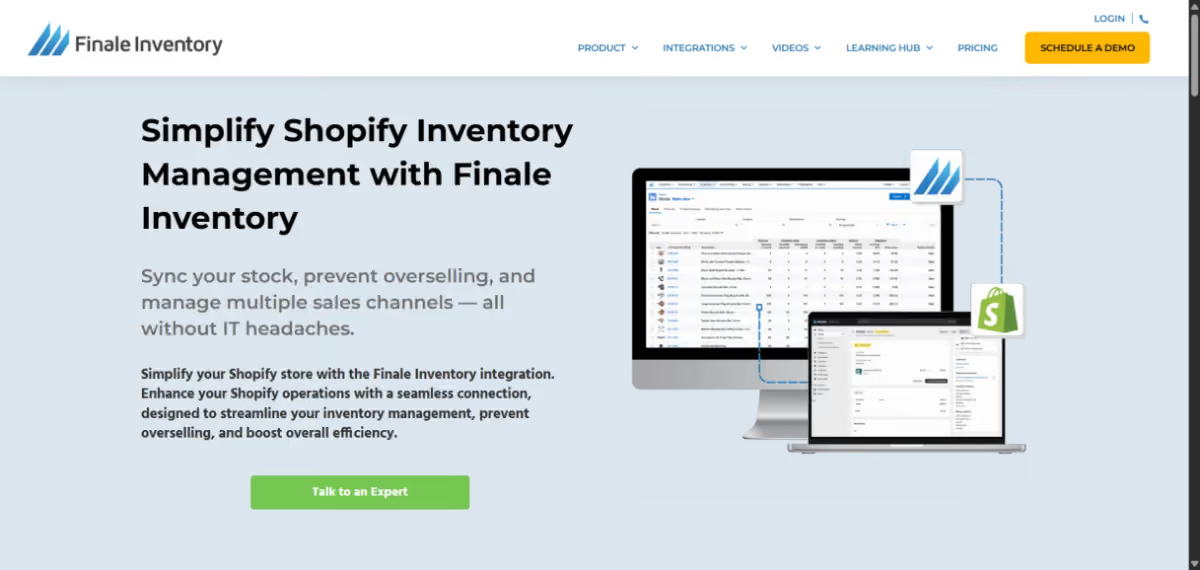
Key features:
- Barcode scanning for stocktakes and receiving.
- Multi-warehouse management
- Kitting and bundle support
- 50+ pre-built inventory, purchase, and sales reports
- Shopify and Amazon sync
- QuickBooks integration
- 14-day free trial
My Testing Results
For me, the barcode scanning workflow was a standout feature. For merchants managing large physical warehouses with regular stocktakes, the accuracy gains from barcode-driven processes will be real and meaningful.
The Shopify sync works, but it isn’t the most real-time of any tool tested. For very high-velocity stores where seconds matter, this is not worth it. The interface also hasn’t kept up with newer tools; it seems functional but dated.
Customer support is consistently highlighted in reviews as a genuine strength that is responsive and technically capable.
Pros & Cons
Strengths: Strong barcode-driven accuracy, solid multi-warehouse control, good kitting support, 50+ reports, excellent customer support.
Weaknesses: Interface feels dated, Shopify sync is less real-time than dedicated tools, better suited to warehouse operations than lean DTC.
Final Verdict
Score: 62/100
A solid tool for the right use case — specifically merchants with large physical warehouse operations and complex stocktaking requirements.
Best for: Mid-sized multichannel retailers and warehouse operators managing high SKU counts across multiple physical locations.
Skip if: You’re a lean DTC brand without warehouse complexity — simpler tools will serve you better at lower cost.
What I Learned From Testing All 10 Tools
A few things became clear after running everything through the same scenarios.
The quality gap is real. 94/100 versus 58/100 isn’t a surface-level difference. It’s the difference between a tool that actively runs your inventory operations and one that gives you a slightly better spreadsheet.
Expensive doesn’t mean better. Sumtracker at $59/month outperforms tools charging $349/month on almost every dimension that matters to a growing Shopify store. The correlation between price and capability is weak in this category.
Most tools are built for a specific use case. Katana is for manufacturers. Extensiv is for enterprise. Veeqo is for shipping-heavy Amazon sellers. Only Sumtracker and Fabrikatör cover the full range of problems a typical Shopify merchant actually has.
Free plans are useful for evaluation. Not for operations. Zoho’s free tier and Veeqo’s free plan give you enough to see how a tool works. Neither is a substitute for a real inventory management system.
How to Choose the Right Tool for Your Store
If you need a complete inventory management system: Sumtracker. Multi-channel sync, bundles, replenishment, forecasting, POs, and reporting in one tool at $59/month.
If a simple PO is your main need: Fabrikatör. The cleanest PO workflow tested, with a backorder engine.
If budget is the deciding factor: Zoho Inventory. The most capable free tier of any tool tested.
If you need a shipping tool: Veeqo. Free, and handles both inventory sync and carrier management.
If you need ERP-level operations: Cin7 or Extensive, as they have the most powerful integrations and the most powerful reporting dashboard tested, if you can justify the cost.
If you manufacture your products: Katana. Nothing else on this list handles production workflows properly.
If you have a large, stable catalogue: Finale Inventory, proven vendor management and reliable forecasting for stable SKUs.
If you need manufacturing and wholesale combined: Unleashed. Strong supply chain visibility from purchasing through to sales.
The right inventory tool ultimately depends on how your business operates today and where you’re headed next.
Try Sumtracker free for 14 days →
Frequently Asked Questions
Does Shopify have built-in inventory management?
Yes, but it’s too basic for a scaling store as it only handles stock tracking, simple transfers, and basic PO creation. For any store beyond the smallest, you’ll need a third-party tool.
What’s the difference between inventory tracking and inventory management?
Tracking tells you what you have. Management tells you what you need, when to order it, how much to order, and where to send it. Most free tools only do the former.
How much does Shopify's inventory management software cost?
Ranges from free (Veeqo, Zoho’s free tier) to $399/month (Unleashed) and beyond for the tools I tested. Sumtracker starts at $59/month and covers the widest feature set at that price point.
Which Shopify inventory tool is best for a store that sells bundles?
As per the testing results, Sumtracker is the best for bundle or kit tracking. It handles bundle tracking very cleanly for a standard Shopify merchant.
When should I switch from Shopify’s native inventory to a third-party tool?
When you start selling on more than one channel, when you start selling bundles, when you need purchase orders, or when you need more than 180 days of inventory history. Any one of those is a signal you’ve outgrown the native admin.
Conclusion
Inventory management for Shopify isn’t just a backend task, it’s the foundation of a smooth, scalable business.
From preventing stockouts and overselling to streamlining operations across sales channels, the right software helps you stay in control as your brand grows.
Each tool we’ve covered offers something unique.
Some are built for simplicity, others for forecasting, bundling, or manufacturing.
The best choice depends on your workflow, team size, and the complexity of your operations.
If you’re at that point where spreadsheets or native Shopify tools are no longer cutting it, now’s the time to upgrade.
Even a small improvement in inventory accuracy can lead to fewer customer complaints, faster fulfillment, and better margins.
In the long run, good inventory software saves time and allows you to focus on growing your brand.

Bhoomi writes about inventory management and multichannel selling at Sumtracker. Her focus is on solving real operational problems for Shopify, Amazon, and marketplace sellers through well-researched content. She covers everything from multi-location inventory syncing and stock error troubleshooting to replenishment planning and platform comparisons, turning complex eCommerce operations into clear, actionable guidance.
LinkedInRelated Articles
Tool and strategies modern teams need to help their companies grow.

Ready to Simplify Your Inventory Management?
Join hundreds of e-commerce merchants who rely on Sumtracker to save time, eliminate errors, and grow their business.