.svg)
The Complete Guide Fulfillment Options for Shopify Inventory


Are you confused by too many options available to fulfil your Shopify orders?
I'm sure you might have already come across the different ways available for fulfilling your orders.
And must also be wondering which one is right for you.
I know it's difficult to make the right decision, as one wrong move can damage your Shopify brand identity.
Yes, you read it right!
As it affects everything from shipping costs and delivery speed to inventory accuracy and customer satisfaction.
In fact, Shopify research found that 60% of consumers expect same-day, next-day, or two-day delivery, and 58% expect that speed without paying extra.
That's one of the reasons why choosing the right fulfillment strategy is a competitive advantage these days.
In this guide, I'll help you understand in detail the major Shopify fulfillment options, compare their costs, explain how they affect inventory management, and help you determine which approach makes the most sense for your business today.
What Are Shopify Fulfillment Options?
Shopify fulfillment options are the different ways orders are picked, packed, shipped, and delivered to customers after a purchase is made.
Shopify allows merchants to fulfill orders themselves, work with third-party logistics (3PL) providers, use Amazon’s fulfillment network, or rely on suppliers through dropshipping and print-on-demand models.
The fulfillment model you choose directly affects shipping costs, delivery speed, customer satisfaction, inventory visibility, and profitability.
A fulfillment setup that works for a store shipping 20 orders per day may seem useless when that same business starts shipping hundreds of orders across multiple sales channels.
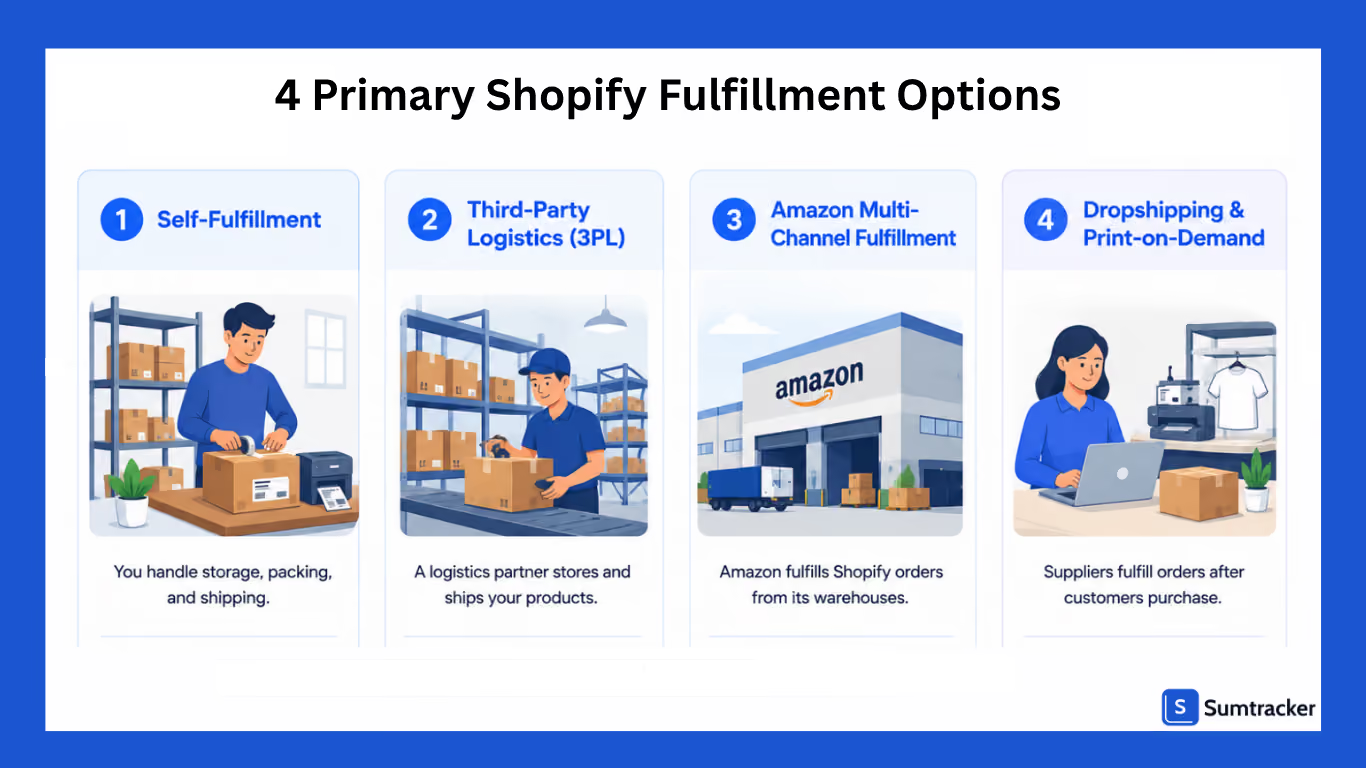
4 Primary Shopify Fulfillment Options
Most Shopify merchants fall into one of four fulfillment categories. Each has advantages and operational challenges that become more pronounced as order volumes grow.
Self-Fulfillment (In-House)
Self-fulfillment means you store the inventory and ship orders with your own support team and have your own warehouse, office, garage, or retail location.
This is often where most Shopify stores begin.
If you have low order volume, self-fulfillment offers maximum control over inventory, packaging, and customer experience.
For example, a new apparel brand shipping 10–30 orders per day can often manage fulfillment internally while maintaining healthy margins.
Advantages of self-fulfillment
- Full control over inventory
- Lower fixed costs initially
- Custom packaging and branding opportunities
- Direct quality control
- Faster issue resolution
Challenges of self-fulfillment
- Labor-intensive operations
- Warehouse space limitations
- Difficulty scaling during peak seasons
- Higher risk of picking and packing errors
- Increased management overhead
Third-Party Logistics Providers (3PLs)
3PL, as the name suggests, is a third party that stores your inventory, picks and packs orders, and ships products on behalf of your business.
Instead of managing warehouse operations yourself, you can send inventory to the logistics provider’s facilities. Orders flow automatically from Shopify to the 3PL, which handles fulfillment.
Popular providers include ShipBob, ShipHero, Flexport, and Red Stag Fulfillment.
For many growing Shopify brands, 3PLs become attractive once daily order volume consistently exceeds 100–200 orders.
Benefits of Using a 3PL
- Faster shipping nationwide
- Access to multiple warehouse locations
- Reduced operational burden
- Easier peak-season scaling
- Lower labor management requirements
Potential Drawbacks
- Additional storage fees
- Pick-and-pack charges
- Less direct control
- Onboarding complexity
- Dependence on external service quality
Amazon Multi-Channel Fulfillment (MCF)
Amazon Multi-Channel Fulfillment allows Shopify merchants to use Amazon’s warehouse network for orders placed outside Amazon.
For example, a customer may place an order through your Shopify store, but Amazon handles picking, packing, and shipping.
MCF gives merchants access to one of the largest fulfillment infrastructures in the United States.
Advantages of Amazon MCF
- Fast nationwide shipping
- Extensive warehouse network
- Reliable delivery performance
- Scalability during high-demand periods
Limitations
- Less branding control
- Potentially higher fulfillment costs
- Dependence on Amazon infrastructure
- Complex inventory forecasting requirements
Inventory Considerations
MCF works well when inventory planning is accurate.
However, because inventory is physically stored in Amazon facilities, you need to closely monitor stock levels, replenishment timelines, and sales velocity to avoid stockouts.
I have seen many growing brands underestimate how quickly inventory depletes when sales occur simultaneously across Shopify, Amazon, Walmart, and other marketplaces, and then they end up with inventory issues.
Dropshipping and Print-on-Demand
Dropshipping removes the need to hold inventory altogether.
When a customer places an order, the supplier manufactures or ships the product directly to the customer.
Print-on-demand businesses operate similarly, producing items only after purchase.
Popular examples include customized apparel, mugs, posters, and accessories.
Benefits
- Minimal upfront investment
- No warehouse costs
- Large product catalog potential
- Reduced inventory risk
Drawbacks
- Lower profit margins
- Limited quality control
- Supplier dependency
- Longer shipping times
- Less predictable customer experience
The Hidden Trade-Off
Many entrepreneurs view dropshipping as the easiest fulfillment model.
While startup costs are lower, operational control is also reduced.
But if the supplier experiences any sort of delays, whether stockouts or production problems, you will have to face the consequences and potential damage to your brand.
For brands focused on long-term customer retention, this trade-off deserves careful consideration.
Why Inventory Visibility Matters
Whichever fulfillment options for Shopify inventory you choose, you need to have a setup to have your inventory sync in real time.
You might think this only applies to 3PL, dropshipping, or Amazon MCF.
But no!
You need to have an inventory management system like Sumtracker to maintain a single source of truth and to know your actual stock levels across fulfillment locations and sales channels.
This challenge is also discussed in the Shopify Partners Radio (Kamari Labs) podcast on Shopify Fulfillment Network, which explains why inventory synchronization becomes increasingly important when merchants outsource fulfillment.
Fulfillment Cost Decision Framework
One of the biggest mistakes merchants make is choosing a fulfillment option based on today's costs instead of where their business will be six months from now.
While every business is different, the framework below can help you decide when it might be time to switch fulfillment models.
Hybrid Fulfillment Strategies: Combining Multiple Fulfillment Methods
Growing Shopify brands don't rely on just one fulfillment method. Instead, they use different fulfillment models for different products, customers, or regions.
Here are a few common examples.
Strategy 1: Local + Nationwide
- Orders within your state → Self-fulfillment
- Orders outside your region → 3PL
This keeps local shipping costs low while allowing customers farther away to receive orders quickly.
Strategy 2: Best Sellers vs Slow Movers
- Fast-moving products → 3PL
- Slow-moving inventory → Self-fulfillment
Keeping slower products in-house helps reduce storage fees charged by 3PL providers.
Strategy 3: Domestic + International
- US orders → 3PL
- International orders → Amazon Multi-Channel Fulfillment
This reduces shipping times while simplifying international logistics.
Strategy 4: Core Products + Print-on-Demand
Many apparel brands stock their best-selling T-shirts but use print-on-demand for seasonal designs and limited-edition collections.
This reduces inventory risk without limiting product variety.
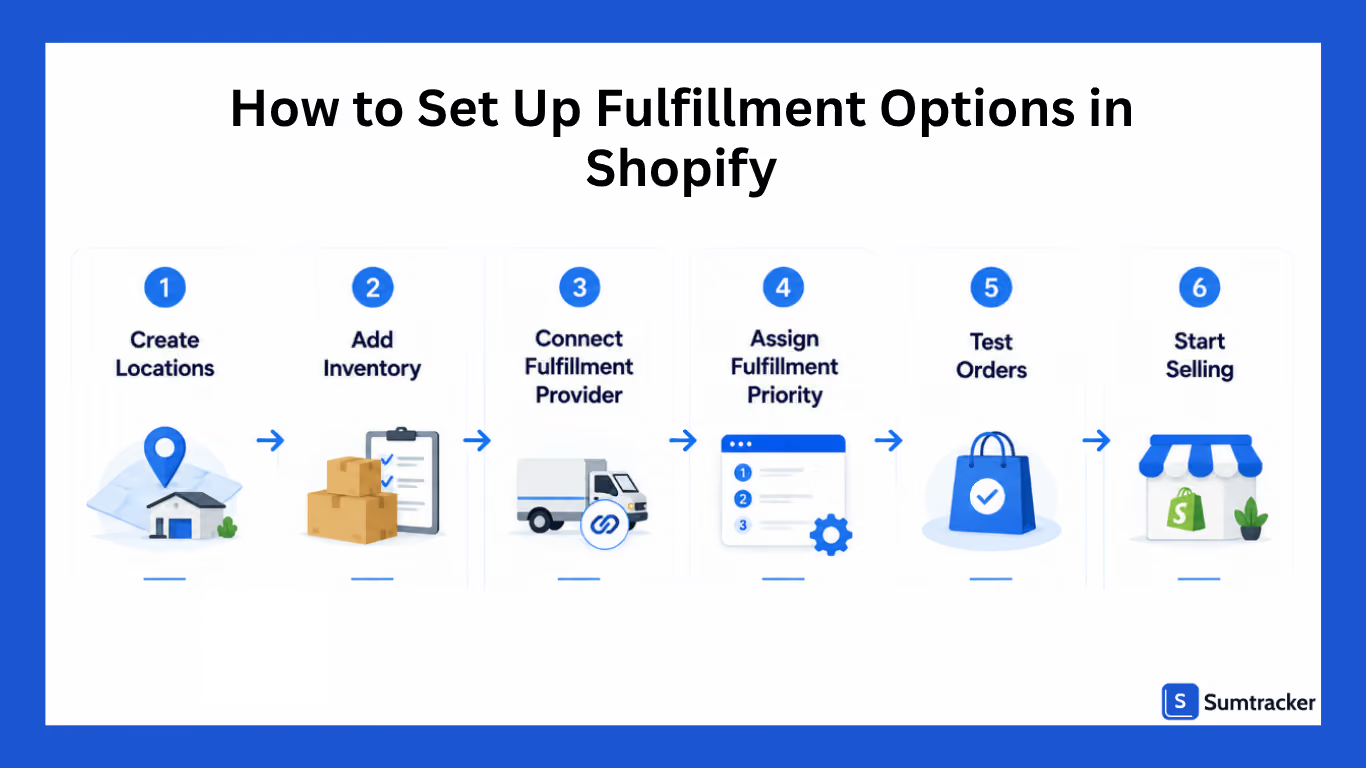
How to Set Up Fulfillment Options in Shopify
Shopify provides built-in tools for configuring fulfillment workflows and inventory locations.
The exact setup depends on your chosen fulfillment model.
Setting Up Locations and Inventory Allocation
Locations represent places where inventory is stored.
Examples include:
- Retail stores
- Warehouses
- 3PL facilities
- Fulfillment centers
Best practice is to establish inventory locations before adding large amounts of inventory.
This ensures inventory quantities remain accurate from the beginning.
Inventory Allocation Framework
When configuring locations:
- Create all fulfillment locations.
- Assign inventory quantities.
- Define location priorities.
- Establish replenishment workflows.
- Monitor inventory movement regularly.
Businesses with multiple locations often benefit from inventory planning software that provides centralized visibility across all warehouses.
Inventory Allocation and Split-Stock Management
As soon as you start using multiple warehouses or fulfillment partners, inventory management becomes much more complicated.
Imagine you have:
- 300 units in your warehouse
- 200 units at a 3PL
- 150 units stored with Amazon MCF
If these inventory levels aren't synchronized properly, you could oversell products or fulfill orders from the wrong location.
Example
A merchant selling skincare products keeps most inventory in a California warehouse but stores fast-moving SKUs in a Texas 3PL to reduce delivery times on the East Coast.
Instead of splitting inventory evenly, stock is allocated based on regional demand, reducing shipping costs while maintaining product availability.
How to Choose the Right Shopify Fulfillment Option
There is no one-size-fits-all strategy that you can swear by. The best option depends upon various factors like business stage, order volume, budget, and customer expectations.
A small store shipping a few orders a day has different needs than a brand fulfilling hundreds of orders across multiple regions.
Start by evaluating these key factors:
- Order volume: Self-fulfillment is often the most cost-effective option for new or low-volume stores. As order volume increases, outsourcing to a 3PL or Shopify Fulfillment Network can save time and improve efficiency.
- Shipping speed: If fast delivery is a priority, choose a fulfillment partner with warehouses located close to your customers. This helps reduce both shipping costs and delivery times.
- Total fulfillment costs: Look beyond monthly fees and compare storage, pick-and-pack, shipping, returns processing, and any additional charges to understand the true cost.
- Product requirements: Ensure the provider can handle your products, whether they're fragile, oversized, temperature-sensitive, or require custom packaging.
- Technology and integrations: Your fulfillment solution should integrate seamlessly with Shopify so orders, inventory, and tracking information stay synced automatically.
Before choosing a fulfillment model, remember that fulfillment isn't just a logistics decision; it affects your entire business.
"For Shopify brands, fulfillment shapes conversion rate, repeat purchase behavior, and support load as much as product quality or paid media."— Robert Shephard, Author and Fulfillment Strategist, Silicon Valley Direct
That's why it's important to evaluate fulfillment options based on more than just cost.
Real-world example
An apparel brand, EasyStandard, struggled with slow shipping, order errors, and billing discrepancies while working with its previous 3PL.
After moving to Shopify Fulfillment Network, the brand strategically distributed inventory closer to customer demand, resulting in 93% on-time deliveries.
The biggest takeaway isn't that Shopify Fulfillment Network is the right choice for every business; it's that the right fulfillment strategy can improve both operational efficiency and the customer experience.
Read the full case study here.
Switching Between Fulfillment Methods Without Disrupting Inventory
Switching fulfillment providers isn't just about moving inventory from one warehouse to another. It also affects your systems, customer experience, and day-to-day operations.
Before making the switch, make sure you have a plan for:
- Updating warehouse and fulfillment settings in Shopify.
- Reconfiguring inventory locations and routing rules.
- Migrating SKU and barcode information.
- Notifying customers if shipping timelines will change temporarily.
- Testing order routing before going live.
- Monitoring inventory reconciliation for the first few weeks after the transition.
The larger the catalog, the more important inventory synchronization becomes during migration.
Managing Returns Across Different Fulfillment Models
Returns can become surprisingly complex when multiple fulfillment methods are involved.
A customer may purchase through Shopify, receive fulfillment through a 3PL, and return the product to a retail location.
Without clear workflows, inventory records quickly become inaccurate.
Best Practices
- Create standardized return procedures.
- Track return reasons consistently.
- Reconcile inventory daily.
- Define return destinations clearly.
- Automate inventory updates whenever possible.
Effective return management protects both customer experience and inventory accuracy.
Common Shopify Fulfillment Mistakes to Avoid
Many fulfillment challenges stem from operational processes rather than technology.
Mistake #1: Choosing Fulfillment Based Only on Cost
The cheapest option may create hidden labor, inventory, and customer service costs.
Mistake #2: Ignoring Inventory Visibility
Inventory accuracy becomes harder as channels and warehouses increase.
Mistake #3: Delaying Fulfillment Upgrades
Waiting too long to outsource can limit growth.
Mistake #4: Poor Inventory Forecasting
Many stockouts result from inaccurate demand planning rather than fulfillment failures.
Mistake #5: No Backup Fulfillment Plan
Unexpected disruptions happen.
A contingency plan reduces operational risk during peak periods.
Frequently Asked Questions
What is the best fulfillment option for Shopify stores?
The best fulfillment option depends on your business size and operational needs. Self-fulfillment works well for new or low-volume stores, while 3PL providers are often a better fit for growing brands that need faster shipping and scalable operations. Businesses selling across multiple channels may also benefit from Amazon Multi-Channel Fulfillment or a hybrid fulfillment strategy.
Can I use multiple fulfillment methods in Shopify?
Yes. Shopify allows merchants to use multiple fulfillment methods simultaneously. For example, you can fulfill best-selling products through a 3PL, handle custom products through print-on-demand suppliers, and ship certain orders from your own warehouse. This approach is commonly known as hybrid fulfillment.
How do fulfillment options affect inventory management?
As inventory is distributed across multiple warehouses, fulfillment centers, or suppliers, maintaining accurate stock levels becomes more complex. Merchants often use inventory management software to keep inventory synchronized across locations and sales channels.
When should I switch from self-fulfillment to a 3PL?
Many merchants start evaluating 3PL providers when fulfillment begins consuming significant time or when order volumes consistently exceed 100–200 orders per day. Other signs include increasing shipping delays, warehouse space constraints, and rising labor costs associated with in-house fulfillment.
Does Shopify have its own fulfillment service?
Shopify supports fulfillment through its platform and integrates with numerous fulfillment providers. Merchants can manage inventory locations, order routing, and fulfillment workflows directly within Shopify while connecting with third-party logistics providers, Amazon Multi-Channel Fulfillment, and other fulfillment solutions.
Conclusion
When choosing the right Shopify fulfillment option for your business, consider factors like your order volume, shipping requirements, inventory complexity, and growth plans.
Many Shopify merchants start with self-fulfillment and gradually transition to a 3PL, Amazon Multi-Channel Fulfillment, or a hybrid strategy as their operations grow.
The important thing is to regularly evaluate whether your current fulfillment setup is helping you deliver orders efficiently while meeting customer expectations.
No matter which fulfillment model you choose, maintaining accurate inventory visibility across your warehouses and sales channels is essential.
With the right fulfillment strategy and inventory management processes in place, you'll be well-positioned to reduce operational challenges, improve the customer experience, and confidently scale your Shopify business.

Bhoomi writes about inventory management and multichannel selling at Sumtracker. Her focus is on solving real operational problems for Shopify, Amazon, and marketplace sellers through well-researched content. She covers everything from multi-location inventory syncing and stock error troubleshooting to replenishment planning and platform comparisons, turning complex eCommerce operations into clear, actionable guidance.
LinkedInRelated Articles
Tool and strategies modern teams need to help their companies grow.

Ready to Simplify Your Inventory Management?
Join hundreds of e-commerce merchants who rely on Sumtracker to save time, eliminate errors, and grow their business.