.svg)
.avif)
How to Update Inventory in Shopify: Complete Guide


Are you looking for ways to update your Shopify inventory but are confused?
I know it’s very important to keep your inventory accurate through regular updates.
And this sounds simple until you’re dealing with product variants, multiple locations, incoming stock, returns, or a large catalog.
Shopify offers you several ways to get this done.
And you must know all these ways to find the right fit for you.
In this guide, we’ll walk you through each method, explain when to use it, and cover common mistakes to avoid when updating your Shopify inventory.
.avif)
Understanding Shopify Inventory: Available vs. On Hand vs. Committed
Before I jump right into the ways you can change your inventory number, it is important to understand what different inventory statuses mean.
- Available: Units that can currently be sold.
- On hand: The total physical inventory recorded at a location.
- Committed: Units allocated to existing orders that haven't been fulfilled yet.
For example, if you physically have 50 units but some are already committed to customer orders, your available inventory will be lower than your total on-hand quantity.
How to Update Inventory for a Product in Shopify
Manual editing is the best and simplest choice if you need to update a small number of products.
Go to Products → Inventory in your Shopify admin, select the relevant location, and find the product you want to update. Enter the new quantity and save your changes.
You can also update inventory from the individual product page.
As discussed in the Inventory Genius Podcast, keeping inventory workflows simple can make day-to-day operations much easier.
Instead of adding unnecessary tools or complicated workarounds, it’s often better to first look at what’s already working and build the simplest process that meets your needs.
Listen to the full podcast here.
Updating Products With Variants
Products with variants, such as different sizes or colors, have separate inventory quantities.
For example, a T-shirt might have separate inventory for:
- Black / Small
- Black / Medium
- Black / Large
- White / Small
- White / Medium
- White / Large
When updating inventory, make sure you're changing the specific variant and location you intended to update.
This is one of the easiest places to make an inventory mistake. Updating the Medium variant won't automatically update the Large variant, even though they're part of the same product.
“Set to” vs. “Adjust by”: Which Should You Use?
Shopify gives you two different approaches to changing inventory.
Use Set to when you've physically counted your stock or identified the exact quantity that should be recorded.
Use Adjust by when you're recording a stock movement, such as receiving new inventory, removing damaged items, or correcting a known difference.
How to Bulk Update Inventory in Shopify
If you manage a large catalog, then bulk update should be your go-to choice.
.avif)
Shopify's bulk editor lets you update multiple products and variants from one spreadsheet-style view.
Go to Products → Inventory, select the products or variants you want to update, and open the bulk editor. Select the inventory fields you need, enter the new quantities, and save.
If your store has multiple locations, pay close attention to the location you're editing.
This becomes especially important as your business grows across multiple locations.
Mandaue Foam, for example, operates across 28 physical locations and used Shopify automation to route orders to locations that had the required inventory.
This helped reduce the need for teams to manually communicate and track orders across locations.
Read the full case study here.
Inventory is tracked separately by location, so changing the quantity at one location won't necessarily change the quantity at another.
For larger catalogs, it's also worth reviewing your changes before saving. A bulk update can be convenient, but an incorrect selection can affect many products at once.
How to Update Shopify Inventory Using a CSV
If you're updating a large number of products, using a CSV can be more efficient than editing products manually.
A practical approach is to export your current inventory first, make the required changes in the file, and then import it back into Shopify.
Shopify CSV Format: Required Fields and Common Mistakes
The safest option is to use Shopify's existing CSV structure rather than creating a spreadsheet from scratch.
Before importing your file, check that:
- Product and variant identifiers haven't been changed accidentally.
- Location names are correct.
- Inventory quantities are entered correctly.
- Required columns haven't been deleted.
- Product variants haven't been mixed up.
- You haven't changed the file structure unnecessarily.
A small formatting mistake can cause an import to fail or, worse, result in incorrect inventory updates. Always review the CSV before uploading it.
How to Fix Common Shopify Inventory Update Problems
If your inventory isn't updating as expected, check a few common issues first.
.avif)
Inventory isn't being tracked:
Make sure inventory tracking is enabled for the relevant product or variant.
The wrong location was updated:
Check which location you're working with before changing the quantity.
Changes aren't saving:
Make sure you've completed the update and saved the changes before leaving the page.
A variant isn't showing the expected quantity:
Open the specific variant and check its inventory separately from the parent product.
CSV import isn't working:
Review the CSV structure, product information, location details, and any error messages Shopify displays during the import.
How to Check and Manage Inventory Changes
After updating your inventory, take a moment to verify the result. Check the product, variant, and location to make sure the new quantity is correct.
Shopify also provides inventory history, which can help you understand previous adjustments when you notice that a quantity doesn't match your physical count.
For stores with a small catalog, Shopify's built-in tools may be enough.
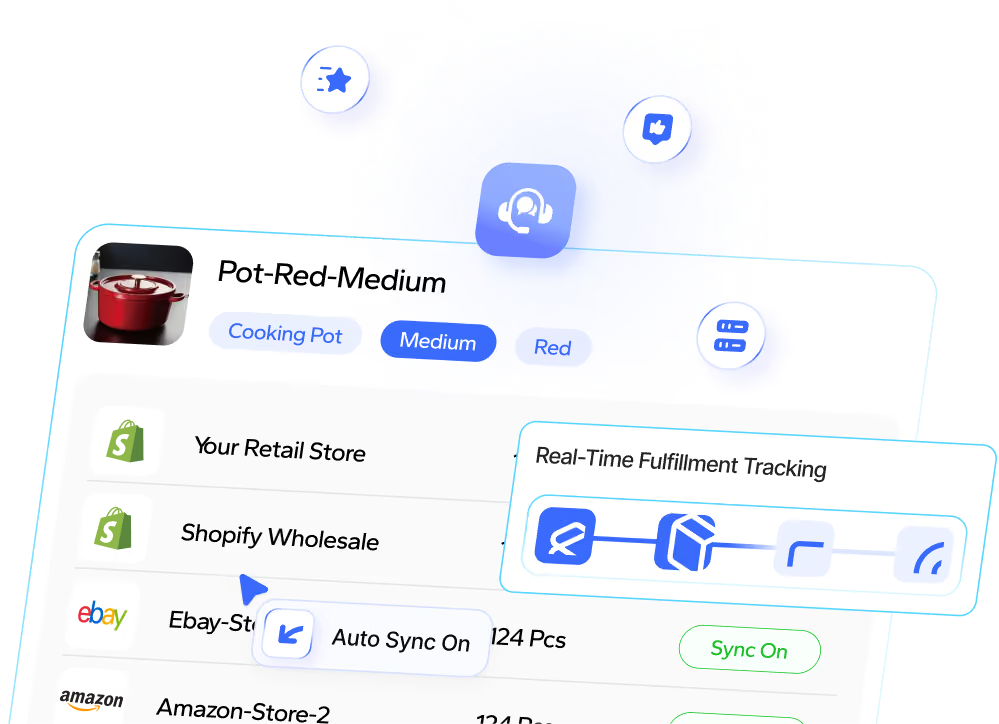
But once you're managing multiple locations, Shopify stores, bundles, or other sales channels, manually keeping everything aligned becomes much harder.
This is where an inventory management tool like Sumtracker can help.
Instead of updating stock separately across different channels, you can enable inventory tracking to prevent overselling.
FAQs
Can I update Shopify inventory in bulk?
Yes. You can use Shopify's bulk editor to update multiple products and variants at once. For larger updates, you can also use a CSV.
How do I update inventory for variants?
Open the product and update the inventory for the specific variant and location you want to change.
What's the difference between “Set to” and “Adjust by”?
Use Set to when you know the exact inventory quantity. Use Adjust by when you're adding or removing a specific number of units.
Why isn't my Shopify inventory updating?
Check that inventory tracking is enabled, you're editing the correct product variant and location, and that you've saved the change. For CSV updates, also check the file structure and formatting.
Conclusion
Updating inventory in Shopify doesn't have to be complicated.
For a small catalog, manual updates are usually enough. As your product count or number of locations grows, Shopify's bulk editor and CSV tools can help you make larger changes more efficiently.
The important part is choosing the right method for the type of update you're making and always checking the product, variant, and location before saving your changes.
A consistent inventory update process can help you avoid inaccurate stock levels, overselling, and unnecessary manual work.

Bhoomi writes about inventory management and multichannel selling at Sumtracker. Her focus is on solving real operational problems for Shopify, Amazon, and marketplace sellers through well-researched content. She covers everything from multi-location inventory syncing and stock error troubleshooting to replenishment planning and platform comparisons, turning complex eCommerce operations into clear, actionable guidance.
LinkedInRelated Articles
Tool and strategies modern teams need to help their companies grow.

.avif)
.avif)
Ready to Simplify Your Inventory Management?
Join hundreds of e-commerce merchants who rely on Sumtracker to save time, eliminate errors, and grow their business.