.svg)
.avif)
8 Best Shopify Themes for Large Inventory Stores for 2026 (Tested & Reviewed)


Do you have hundreds or thousands of products in your Shopify store?
Or, in Shopify's terms, should I say a catalog size that falls under the category of "lots"?
A Shopify theme has to do more than just look good.
Not having the right theme for your catalog size can make your customers suffer when they try to navigate through your website.
And I understand this problem of yours.
So, to help you make the right choice, I evaluated 8 Shopify themes based on the criteria for handling 500+ products.
But that's not the only criterion on which I have curated these 8 themes.
My assessment of these tools wasn't limited to how well they can handle large inventory; it also focused on navigation, filtering, search, performance considerations, mobile usability, and merchandising.
Quick Results: My Top Picks
- Best Overall — Enterprise: Excellent navigation, search, filtering, and performance for large catalogs.
- Best for B2B & Wholesale — Hyper: Strong catalog tools plus quick ordering and B2B features.
- Best Value — Xtra: Large-catalog features at a much lower price than most premium options.
- Best for Fashion — Impulse: Combines powerful catalog navigation with visual merchandising.
- Best for Beauty — Pearl: Strong filtering, swatches, and product discovery for attribute-heavy beauty catalogs.
How I Evaluated Shopify Themes for Large Inventories
While researching, I came across multiple Shopify theme roundups that were mainly focused on how the theme looks, how many sections they have, and, of course, their popularity.
But for a large catalog, solely judging on these parameters isn't ideal.
A theme can look excellent and still make it frustrating to browse 2,000 products.
For this comparison, I evaluated each theme against the specific problems that become more important as a catalog grows.
My scoring methodology
What I looked for-
Navigation: Can shoppers move through multiple levels of categories without getting lost?
Filtering: Does the theme support the filtering functionality needed to narrow large collections?
Search: Does it provide enhanced search and make product discovery easier when browsing becomes impractical?
Performance: Does the theme appear designed with large storefronts in mind, and does it avoid making unsupported claims about speed?
Mobile: Can shoppers navigate large collections and filters comfortably on smaller screens?
Merchandising: Can merchants organize and present large collections without every category page becoming visually repetitive?
Scalability: Does the theme have features such as infinite scroll, quick order, combined listings, or B2B functionality that become useful as a store grows?
What my rating does not mean
Before jumping into the list of themes, I want to clarify that the ratings I have given have no relation to Shopify's rating or Lighthouse scores.
My ratings are based on how the themes performed on my set standards.
These aren't Shopify's ratings, Lighthouse scores, or guarantees of storefront performance.
Note: Shopify itself emphasizes that theme performance depends on implementation and recommends measuring Liquid rendering and storefront performance rather than assuming that a theme will perform identically in every store.
What Qualifies as a "Large Inventory" Shopify Store?
There is no set standard product count that suddenly turns a Shopify store into a large-inventory store.
For a practical benchmark, Shopify's own Theme Store uses 500+ products as its "Lots" catalog-size category.
For this article, I'd use the following framework:
- Under 100 products: Basic navigation is usually sufficient.
- 100–500 products: Search, collection organization, and filtering become increasingly useful.
- 500–1,000 products: Navigation and faceted filtering become important.
- 1,000–10,000 products: Search, filtering, taxonomy, and collection architecture become central to the shopping experience.
- 10,000+ products: Merchants need to pay particular attention to search, filtering, pagination, performance, and catalog architecture.
These are practical editorial ranges, not Shopify limits.
And there's an important distinction between products in the store and products in an individual collection.
Shopify's Search & Discovery documentation, for example, notes that filters aren't displayed on collections containing more than 5,000 products.
Shopify recommends breaking very large collections into smaller, more useful categories instead.
Comparison of the Best Shopify Themes for Large Inventories
1. Enterprise — Best Overall for Large Catalogs
My rating: 9.4/10
Best for: Large catalogs where navigation, search, filtering, and performance all matter.
Price: $420
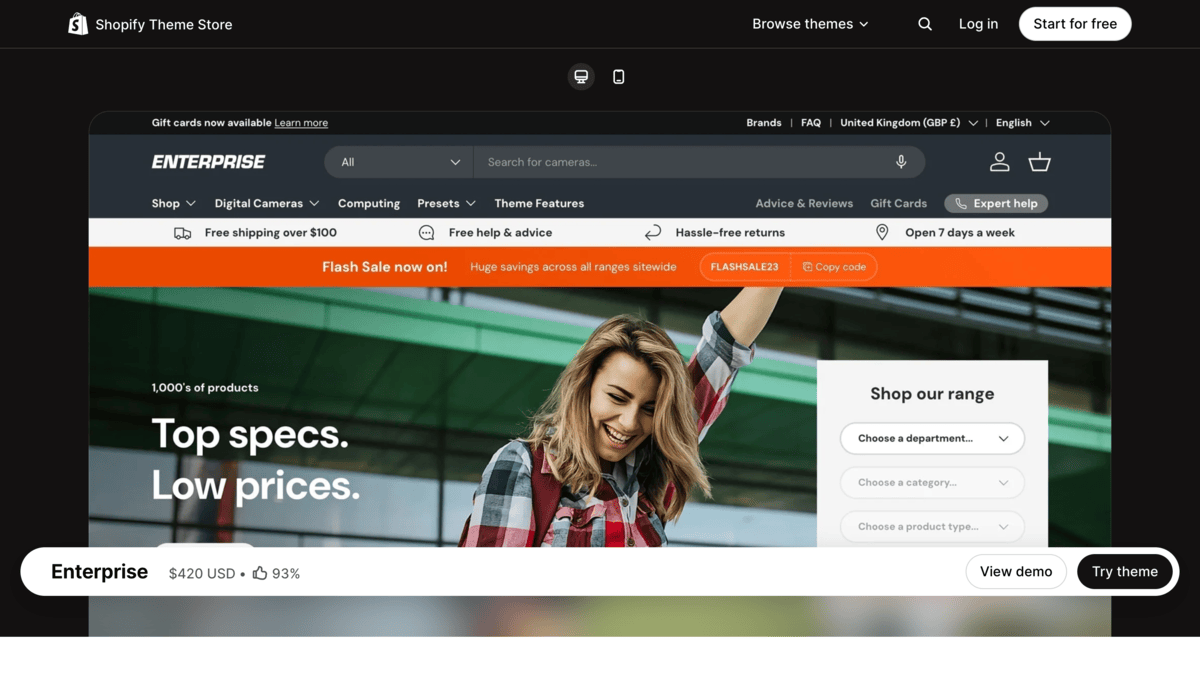
Enterprise is the strongest all-round option in this comparison because its feature set lines up unusually well with the problems large catalogs create.
Its Shopify listing includes enhanced search, infinite scroll, mega menus, product filtering and sorting, breadcrumbs, collection navigation, and swatch filters.
It also has a strong performance focus. Clean Canvas says the theme was built without external libraries or bloated code and focuses on storefront speed.
Why it scores highly
Navigation — 9.5/10 Mega menus, breadcrumbs, and collection navigation give large catalogs several ways to structure discovery.
Filtering — 9.5/10 Product filtering and sorting plus swatch filters make it particularly suitable for attribute-heavy catalogs.
Search — 9.2/10 Enhanced search is built in.
Performance readiness — 9.6/10 The theme has a particularly strong performance positioning, although its real-world speed will still depend on implementation.
Mobile — 9.2/10 Its broad product-discovery feature set translates well to mobile catalog browsing.
Where Enterprise stands out
The combination of infinite scroll + filtering + enhanced search is particularly useful for large collections. Shopify itself recommends using filters to help customers narrow large collections rather than relying on deep pagination.
Who should choose Enterprise?
If your store has hundreds or thousands of products and you want the theme to do a lot of the storefront heavy lifting.
It's particularly attractive for electronics, home goods, general merchandise, and other stores where customers need multiple ways to narrow their choices.
Verdict: The best overall fit in this list for a genuinely large catalog.
2. Hyper — Best for B2B and Wholesale Catalogs
My rating: 9.3/10
Best for: B2B, wholesale, and complex product catalogs.
Price: $400
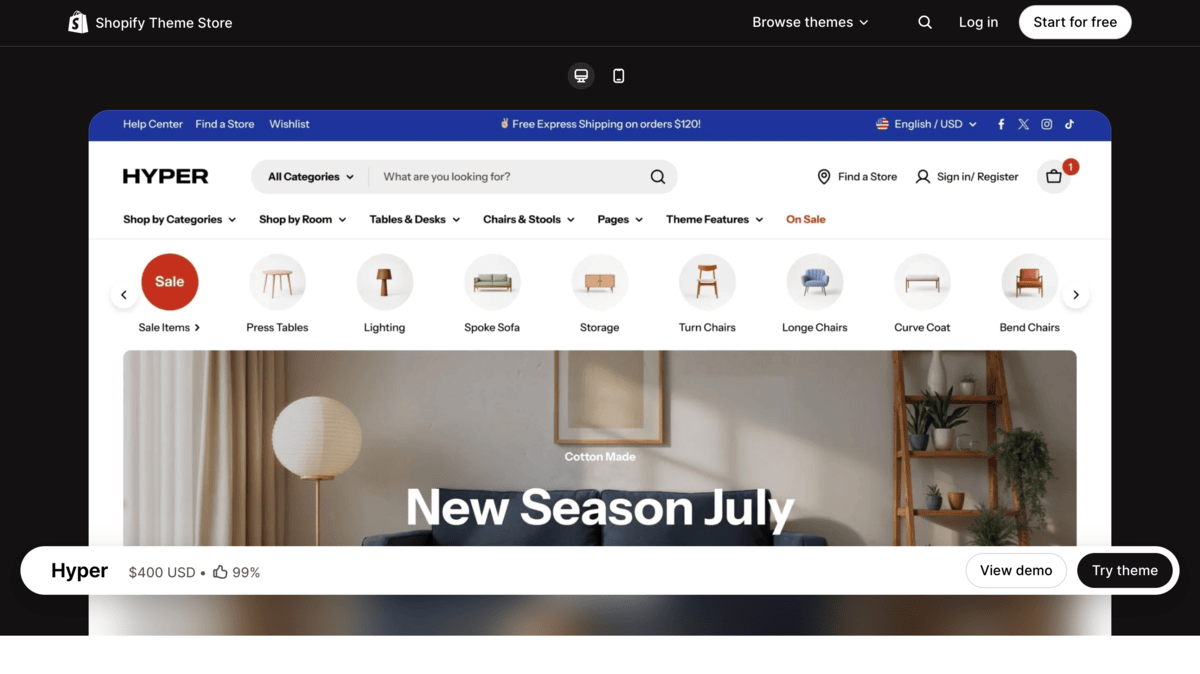
Hyper is one of the easiest themes to justify for large inventories because its positioning is explicitly aimed at high-growth B2B and wholesale brands.
Its feature set includes enhanced search, infinite scroll, mega menus, filtering and sorting, collection navigation, quick order lists, quantity pricing, and Shopify Plus functionality.
Why it scores highly
Navigation — 9.5/10 Mega menus, breadcrumbs, and collection navigation support complex catalog structures.
Filtering — 9.5/10 Filtering, sorting, and swatch filters are built in.
Search — 9.2/10 Enhanced search makes product discovery easier in larger catalogs.
Scalability — 9.5/10 This is where Hyper really separates itself. Quick order functionality, B2B features, quantity pricing, and combined listings make it more appropriate for complex commercial catalogs.
Where Hyper stands out
Hyper isn't particularly designed for customers who browse through products.
If you are into B2B, then its features are relevant to you because your customers already know what they want to buy, and they just want to quickly find it and place the order.
Verdict: If your "large inventory" is also a large wholesale catalog, Hyper should be near the top of your shortlist.
3. Ignite — Best for Feature-Rich Catalogs
My rating: 9.1/10
Best for: Electronics, growing brands, and catalogs that need extensive built-in functionality.
Price: $380
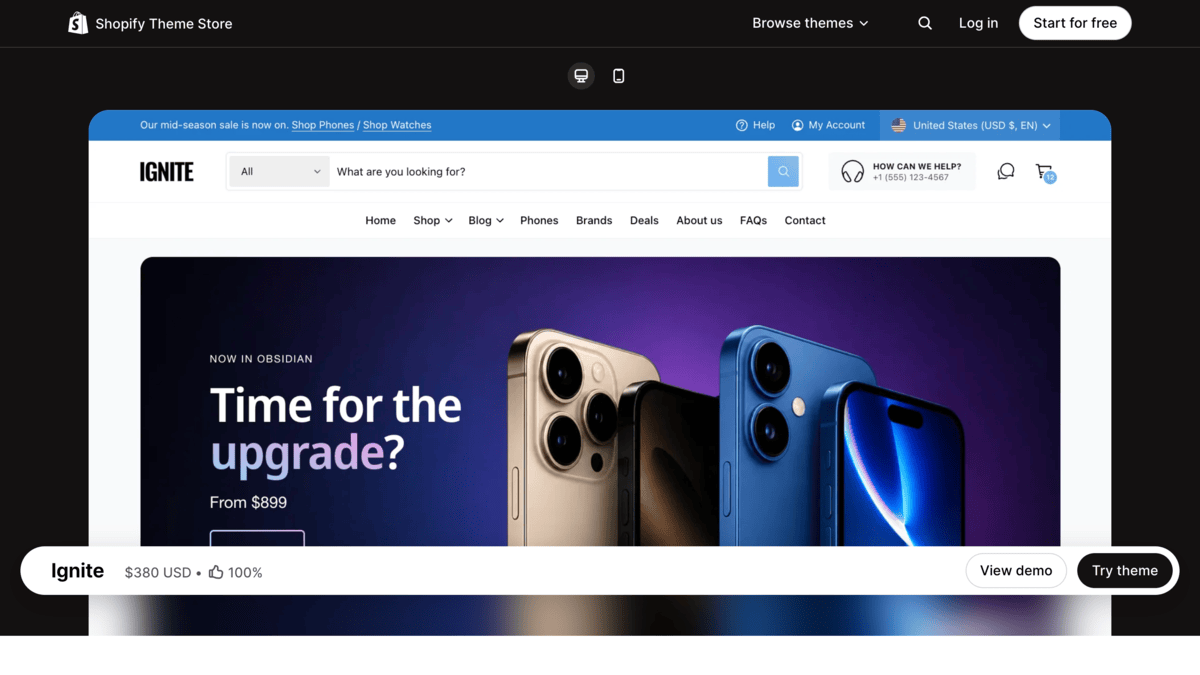
Ignite combines a large feature set with strong catalog-discovery functionality.
Its Shopify listing includes enhanced search, infinite scroll, mega menus, product filtering and sorting, collection navigation, breadcrumbs, and swatch filters.
It also includes quick order functionality and Shopify Plus features such as quantity pricing and combined listings.
Why it scores highly
Navigation — 9.1/10 Strong menu and collection capabilities.
Filtering — 9.2/10 Filtering, sorting, and swatch filters make it suitable for attribute-heavy collections.
Search — 9.0/10 Enhanced search is included.
Scalability — 9.3/10 Infinite scroll, quick order, combined listings, and B2B-oriented functionality give it plenty of room to grow.
Ignite is also explicitly positioned as B2B-ready, while its 50+ sections give merchants considerable flexibility in structuring product and category pages.
Verdict: A strong choice if you want a feature-rich theme without immediately turning to multiple third-party apps.
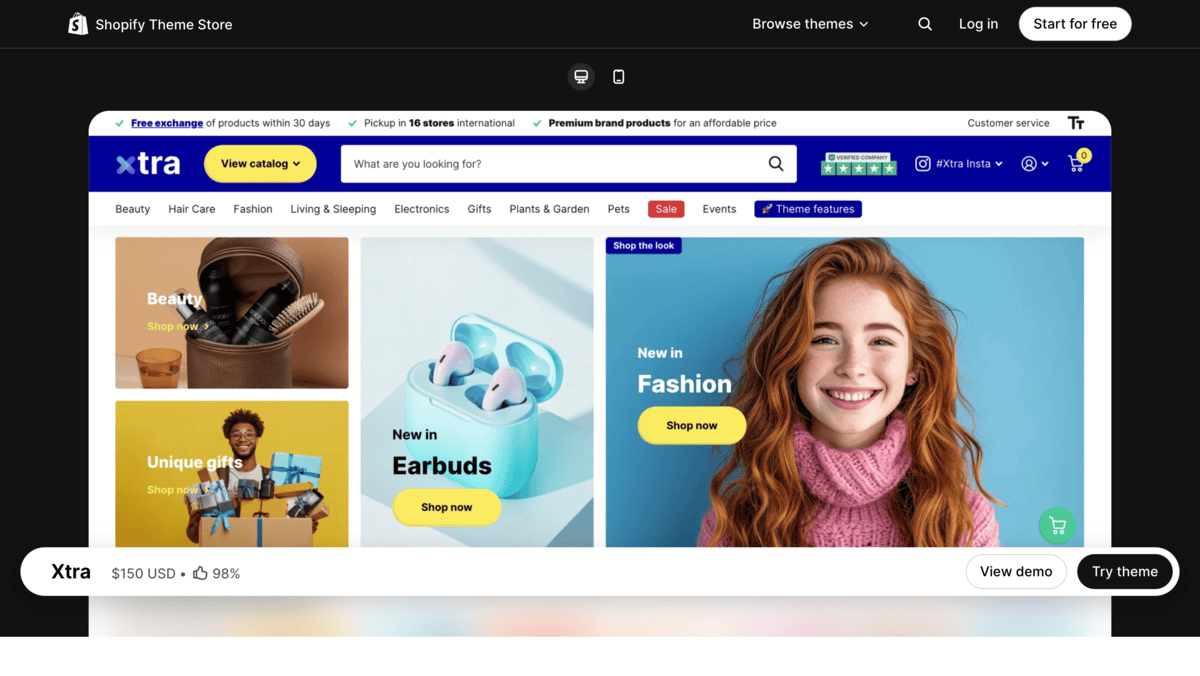
4. Xtra — Best Value for Large Catalogs
My rating: 9.1/10
Best for: Merchants who want extensive catalog functionality without a high theme price.
Price: $150
Xtra is the biggest value play in this list.
At $150, it's cheaper than the other premium themes here, while still including enhanced search, infinite scroll, mega menus, product filtering and sorting, collection navigation, and swatch filters.
It also includes quick order functionality, quantity pricing on Shopify Plus, and a large number of built-in merchandising features.
Why it scores highly
Navigation — 9.2/10 Mega menus and collection navigation are well suited to broad catalogs.
Filtering — 9.2/10 Strong built-in filtering support.
Search — 9.0/10 Enhanced search is included.
Value — 10/10 At $150, its feature-to-price ratio is difficult to ignore.
Xtra also has a substantial review history compared with the newly launched Soft presets: Shopify currently shows 401 reviews across its presets and 98% positive sentiment.
Verdict: If you need large-catalog functionality but don't want to spend $400–$500 on a theme, Xtra is the obvious value candidate.
5. Impulse — Best for Fashion and Merchandising
My rating: 9.0/10
Best for: Fashion, apparel, and visually driven stores with substantial product assortments.
Price: $500
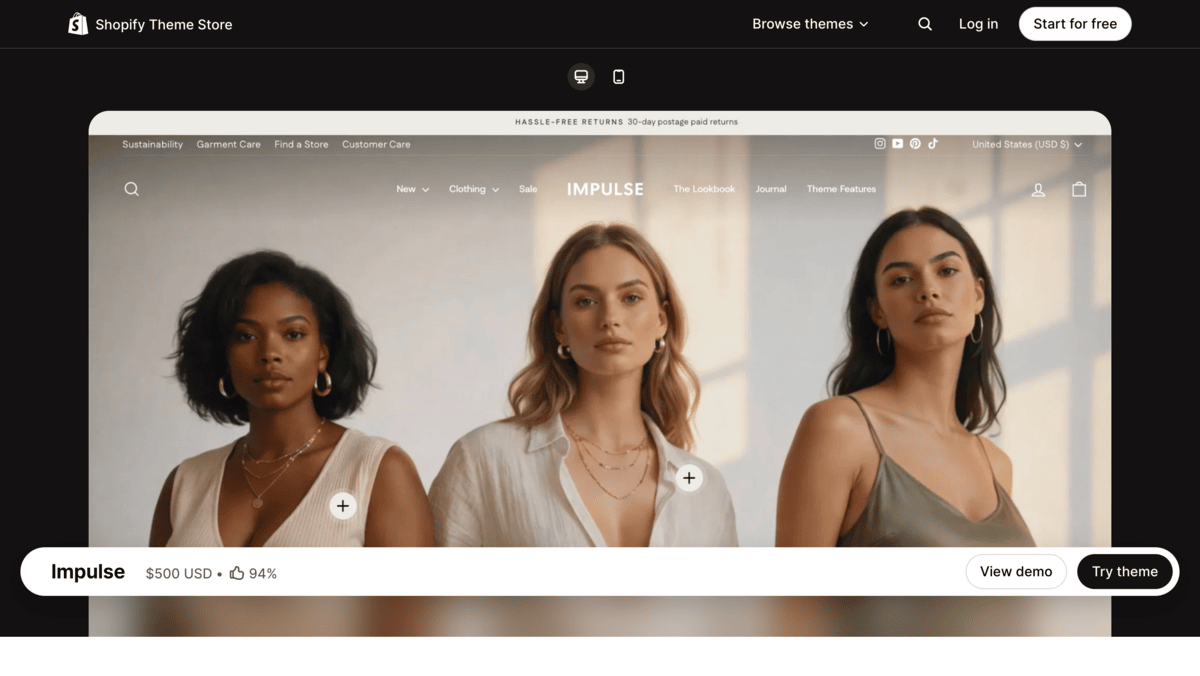
Impulse is the most expensive theme in this comparison, but its strength is less about being a utilitarian catalog framework and more about combining catalog navigation with sophisticated merchandising.
Its Shopify feature list includes enhanced search, mega menus, collection navigation, product filtering and sorting, breadcrumbs, and a sticky header.
It also has a particularly extensive set of visual merchandising tools, including lookbooks, image galleries, product videos, product tabs, color swatches, and Shopify Plus combined listings.
Why it scores highly
Navigation — 9.0/10 Strong core catalog-navigation capabilities.
Filtering — 9.0/10 Filtering and sorting are built in.
Mobile — 9.2/10 The theme explicitly emphasizes responsive storefront design.
Merchandising — 9.6/10 This is its strongest category.
The trade-off
Impulse is expensive, and its strength is particularly relevant to fashion and visual commerce.
If you're selling industrial components, spare parts, or technical equipment, its visual merchandising strengths may be less valuable than Hyper's B2B capabilities.
Verdict: Excellent for a large fashion catalog where product discovery and visual merchandising need to work together.
6. Graceful — Best for Fashion Catalogs
My rating: 8.5/10
Best for: Fashion stores with moderately large, visually driven catalogs.
Price: $270
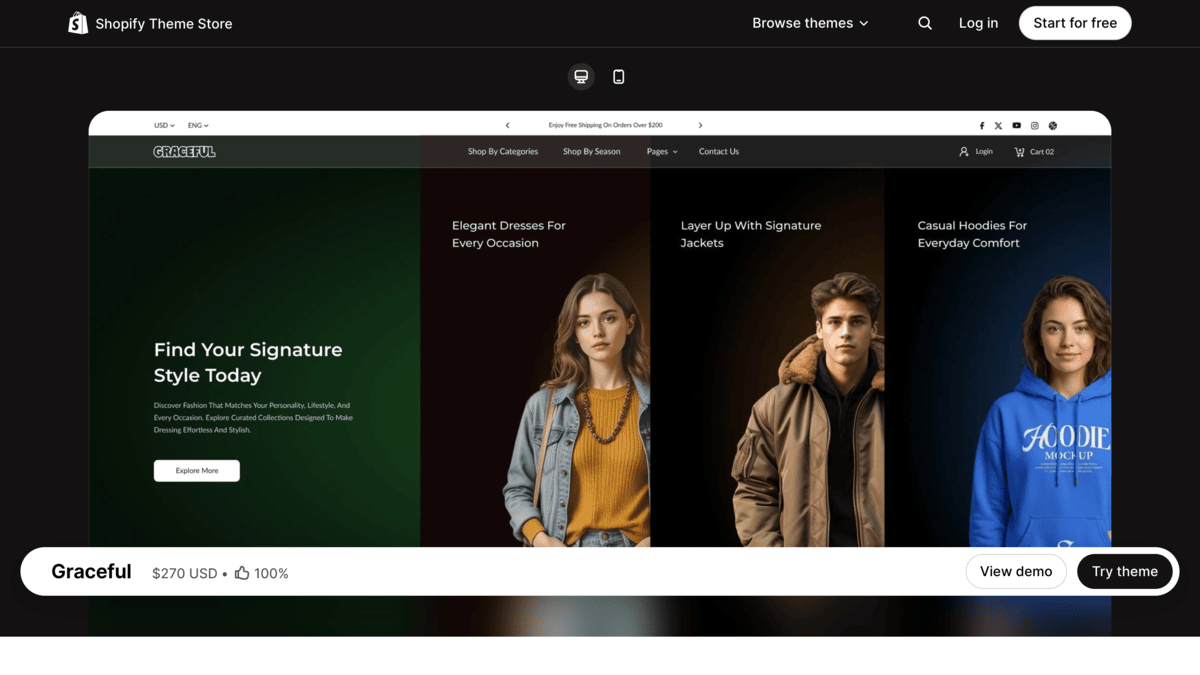
Graceful is a preset of the Soft theme, designed specifically around fashion. Shopify describes it as a fashion theme for modern brands, curated collections, and style.
Its catalog functionality includes enhanced search, mega menus, collection navigation, product filtering and sorting, breadcrumbs, sticky headers, and swatch filters.
Why it scores well
Graceful is particularly suited to catalogs where color, size, and visual product discovery matter.
It includes color swatches, size charts, image galleries, product videos, and other visual merchandising tools.
Why it doesn't rank higher
The Soft framework doesn't include some of the large-catalog-oriented capabilities found in Hyper, Enterprise, Ignite, and Xtra, such as infinite scroll and quick-order functionality.
That doesn't make Graceful a poor choice. It simply means I'd choose it for a fashion catalog that is large but still highly curated, rather than a 10,000-SKU general merchandise operation.
Verdict: A strong fashion-first option, but not our first choice for extremely complex catalogs.
7. Pearl — Best for Beauty Catalogs
My rating: 8.5/10
Best for: Beauty and cosmetics stores with many products, shades, and product attributes.
Price: $270
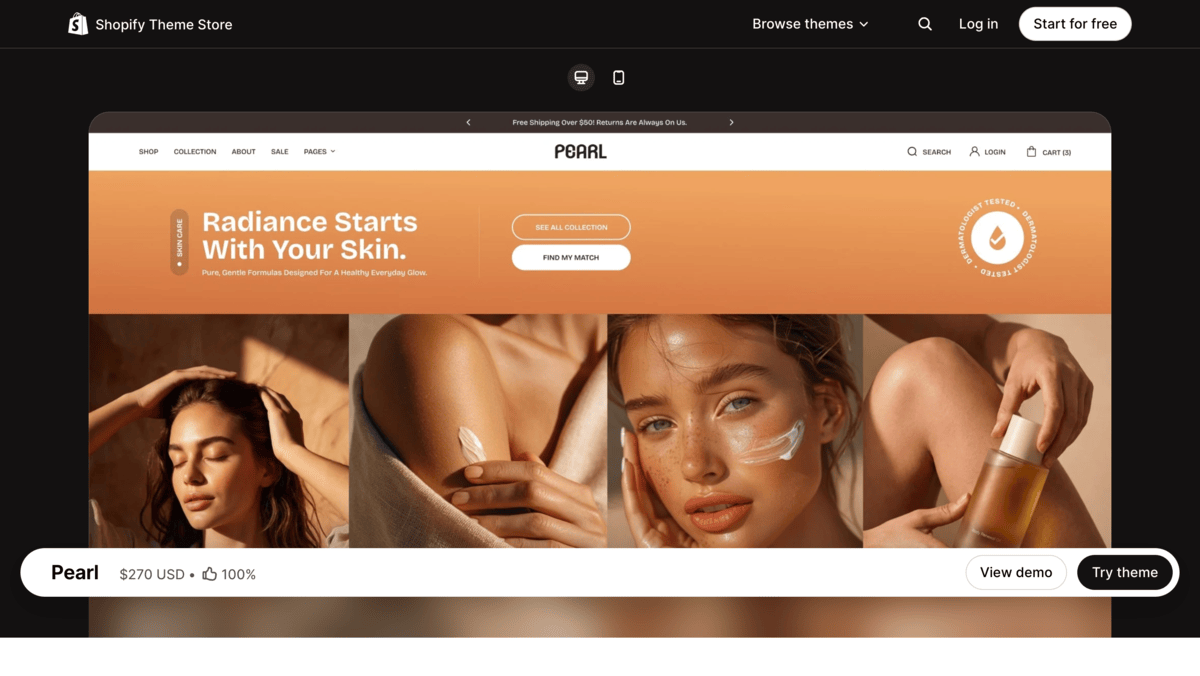
Pearl is another Soft preset, this time designed for beauty brands.
Shopify describes it as focused on personalized beauty discovery, shade selection, and curated product recommendations.
It has the same fundamental catalog-discovery capabilities as the other Soft presets: enhanced search, mega menus, collection navigation, filtering and sorting, breadcrumbs, and swatch filters.
Where Pearl works particularly well
Beauty catalogs often have attributes that customers actively want to filter by:
- Shade
- Color
- Product type
- Skin/hair concern
- Brand
- Finish
- Size
Pearl's swatch functionality and beauty-focused product discovery make it more compelling for this use case than its generic score might suggest.
The limitation
If your store has thousands of products spread across many unrelated categories, Enterprise or Hyper provides a stronger large-catalog framework.
Pearl is better thought of as a specialized large-catalog option.
Verdict: A good choice when catalog complexity comes from beauty attributes and product discovery, rather than sheer SKU volume.
8. Merit — Best for Specialized, Guided Product Discovery
My rating: 8.5/10
Best for: Specialized catalogs where shoppers benefit from guided discovery.
Price: $270
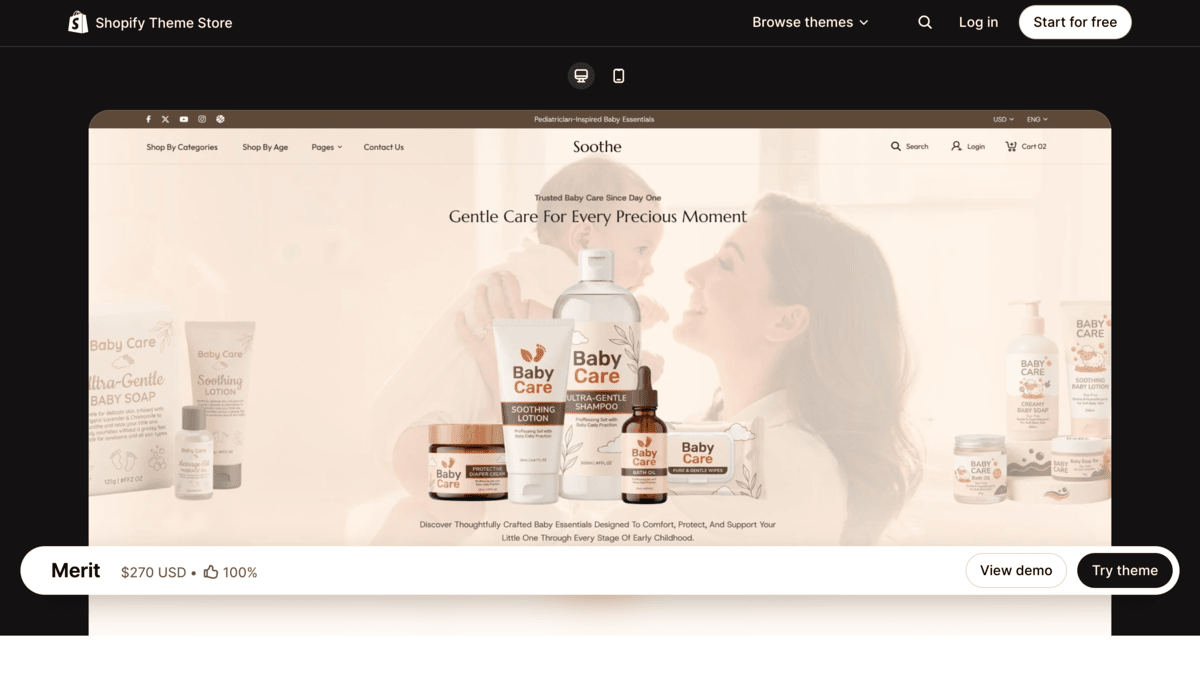
Shopify's current listing positions it around age-based discovery and organized product discovery, with enhanced search, mega menus, collection navigation, filtering and sorting, and swatch filters.
One caveat is worth mentioning: Shopify's current page describes Merit as a baby-care theme, while the August 2026 release notes describe the preset as being designed for wellness brands. Because of that discrepancy, I would avoid making the article's recommendation overly dependent on the exact industry label.
Where Merit works
The interesting part of Merit isn't raw catalog capacity. It's guided discovery.
For a specialized store, customers may think in terms of:
Age → Product type → Need → Product
rather than:
Browse → Page 1 → Page 2 → Page 3
That makes the preset potentially useful for catalogs where customers need help identifying the right product.
Why it ranks below the larger catalog specialists
Like Pearl and Graceful, Merit doesn't have the same large-catalog-oriented feature breadth as Enterprise, Hyper, Ignite, or Xtra.
Verdict: Better for a specialized, guided shopping experience than for an enormous general-purpose catalog.
Which Shopify Theme Is Best for Your Inventory Type?
If you want an inventory-wise segmentation of which Shopify theme would suit your store, then I got you!
Fashion and Apparel
If you sell clothes, accessories, jewelry, etc then the best picks are Impulse and Graceful.
Impulse is the stronger choice for a larger, merchandising-heavy fashion business, while Graceful is better suited to a more curated fashion catalog.
Electronics and Tech
Electronics catalogs have many technical attributes. Best-suited themes are Enterprise and Ignite.
Their combination of enhanced search, filtering, mega menus, and collection navigation makes them better suited to attribute-heavy product discovery.
B2B, Parts and Supplies
Here, shoppers may already know exactly what they're looking for.
Search, quick ordering, deep categorization, and structured navigation become more important than visual merchandising.
You can go for Hyper.
Its B2B positioning, quick-order functionality, quantity pricing, enhanced search, filtering, and mega menus make it the clearest fit.
Beauty and Personal Care
Beauty catalogs tend to have complex attributes such as shade, concern, finish, and product type.
Go for Pearl without any doubt.
Its beauty-specific product-discovery approach and swatch functionality make it a particularly natural fit.
General Merchandise
If you sell products across many categories and simply need the strongest all-round catalog experience.
Enterprise should be your choice.
Its combination of navigation, search, filtering, infinite scroll, and performance positioning gives it the broadest fit.
Mobile Navigation Strategies for Large Catalogs
Large catalogs are particularly difficult on mobile because you lose the horizontal space available for desktop navigation.
A good mobile experience should make it easy to:
- Open the main navigation.
- Drill into categories.
- Return to a previous category.
- Search directly for a product.
- Open and apply filters.
- See which filters are currently active.
- Clear filters without restarting the shopping journey.
Don't simply reproduce the desktop mega menu on mobile.
For large catalogs, search and filtering should become increasingly prominent as navigation depth increases.
That's consistent with Shopify's own guidance around large collections: filtering is preferable to forcing customers through increasingly deep pagination.
How to Improve Search and Filtering for Large Inventories
Only selecting the theme that suits your storefront doesn't get your work done.
It's only half the work.
You still need to work on the quality of your catalog data, because any sort of inconsistency is going to mess up the search and filtering.
For example, a clothing store won't get much value from a "Size" filter if some products use:
- S / M / L
- Small / Medium / Large
- Small-Medium / Medium-Large
as inconsistent product attributes.
Shopify's Search & Discovery system can use product options, product metafields, category metafields, and variant metafields as filter sources.
That means large catalogs should have a consistent product-data structure before investing heavily in advanced filtering.
Themes provide you with a strong foundation, but it isn't the entire discovery stack.
You can use a search app if your store has thousands of SKUs, complex tech attributes, heavy SKU-based purchasing, and advanced synonym requirements.
How to Optimize Shopify Theme Performance for Large Catalogs
If you think that every page needs to load thousands of products, then you are going in the wrong direction.
It doesn't mean that at all.
Shopify's theme-development guidance recommends limiting the number of products fetched and rendered.
Its documentation notes that collection products have a default page size of 50 and recommends pagination for collection products.
Shopify also recommends keeping pagination depth below 25,000 objects and using filters to help shoppers narrow results, rather than relying on extremely deep pagination.
A technically well-built theme can still slow down after a merchant adds 20 apps and thousands of large images.
When You Need Apps to Supplement Your Theme
A Shopify theme controls the storefront experience. It doesn't replace every ecommerce system behind the storefront.
You may still need separate apps for:
- Advanced search
- Product reviews
- Advanced filtering
- Product recommendations
- Inventory management
- Purchase orders
- Multi-channel inventory synchronization
- Back-in-stock alerts
- B2B workflows
This distinction is especially important for large-inventory merchants.
A theme can make 5,000 products easier to browse, but it doesn't automatically solve stock accuracy, purchasing, inventory forecasting, or inventory synchronization.
For example, merchants managing inventory across multiple Shopify locations or sales channels may need dedicated inventory management software such as Sumtracker alongside their storefront theme.
Implementation Tips for Large Inventory Shopify Stores
Choosing the right Shopify theme is great, but you should also know implementation tips so that you can get your store running better.
1. Build your catalog hierarchy before designing the navigation
Don't start by creating a mega menu.
First determine:
Department → Category → Subcategory → Product
Then build the navigation around that structure.
2. Standardize product attributes
Don't represent the same attributes with different names, like Black, black, and Jet black. If they mean the same, this can mess up your filtering.
3. Don't create one enormous collection
Shopify's Search & Discovery documentation specifically recommends splitting collections when they exceed 5,000 products because filters aren't displayed on collections above that threshold.
4. Test with real product data
A theme demo with 20 products doesn't tell you much about a store with 3,000.
Before publishing, test your actual:
- Product names
- Categories
- Filters
- Variants
- Images
- Search terms
- Mobile navigation
5. Audit apps after installing the theme
A fast theme can become slow because of third-party scripts.
6. Test product discovery, not just page appearance
Ask someone unfamiliar with the store to find five different products.
Watch where they get stuck.
That's often more useful than another visual design review.
Frequently Asked Questions
1. What is the best Shopify theme for a large inventory?
There is no single Shopify theme that's best for everyone; it depends on what you sell and how many products you have.
2. How many products is considered a large inventory on Shopify?
There isn't a fixed definition, but Shopify categorizes stores with 500+ products as having "Lots" of products. The right theme also depends on how complex your categories, variants, and product attributes are.
3. What features should I look for in a Shopify theme for a large catalog?
Prioritize mega menus, advanced filtering, enhanced search, clear collection navigation, mobile-friendly browsing, and performance optimization.
4. Can Shopify themes handle thousands of products?
Yes. Shopify can support large product catalogs, but your theme should make it easy to search, filter, and navigate those products without loading unnecessary content on each page.
5. Does having a large inventory affect Shopify store performance?
A large product catalog doesn't automatically slow a Shopify store. Performance is more likely to be affected by factors such as large images, third-party apps, custom code, and how many products or sections a page loads at once.
Conclusion
Choosing a Shopify theme for a large inventory isn't just about picking the one with the best-looking homepage.
Once your catalog grows, customers need simple ways to find the right product without clicking through endless collections.
Enterprise is our top overall pick because it offers the strongest balance of navigation, search, filtering, and performance-focused features. Hyper is a better fit for B2B and wholesale stores, while Xtra stands out if you're looking for strong large-catalog features at a lower price.
For more specialized stores, Impulse, Pearl, Graceful, and Merit can make sense depending on your products and how customers shop.
The key is to choose a theme based on how your customers navigate your catalog, not just how many products you have.

Bhoomi writes about inventory management and multichannel selling at Sumtracker. Her focus is on solving real operational problems for Shopify, Amazon, and marketplace sellers through well-researched content. She covers everything from multi-location inventory syncing and stock error troubleshooting to replenishment planning and platform comparisons, turning complex eCommerce operations into clear, actionable guidance.
LinkedInRelated Articles
Tool and strategies modern teams need to help their companies grow.


Ready to Simplify Your Inventory Management?
Join hundreds of e-commerce merchants who rely on Sumtracker to save time, eliminate errors, and grow their business.