.svg)
.avif)
Demand Forecasting for eCommerce: A Complete Guide


Inventory is the single largest expense most eCommerce brands miscalculate.
Not because they don’t have data but because they don’t know how to turn that data into predictable demand.
One month you’re scrambling to restock. The next, cash is locked in slow-moving SKUs. The real issue isn’t sales. It’s forecasting.
Demand forecasting gives structure to growth. It helps you anticipate what will sell, when it will sell, and how much inventory you actually need to support it. Instead of reacting to spikes and shortages, you plan around them.
And that shift from guessing to predicting is what separates stable brands from chaotic ones.
In this guide, we’ll break down exactly how demand forecasting works in eCommerce and how to apply it practically across Shopify, Amazon, and other marketplaces.
What Is Demand Forecasting in eCommerce?
Demand forecasting in eCommerce is the practice of using historical sales data, market trends, and business insights to predict how much of a product you’ll sell in the future.
Instead of reordering based on instinct (“We sold a lot last month, let’s order more”), you use actual data to answer questions like:
- How many units will we sell in the next 30, 60, or 90 days?
- When will we hit our reorder point?
- How much safety stock do we need?
- How will seasonality affect demand?
It transforms inventory planning from reactive to proactive.
At its core, demand forecasting connects three key areas:
- Sales velocity
- Lead times (supplier & shipping)
- Safety stock planning
When these are aligned, inventory decisions become predictable not stressful.
.avif)
Why Demand Forecasting Is Critical for Online Retail Growth
Growth in eCommerce isn’t just about increasing sales, it’s about supporting those sales without breaking your operations. And that’s where demand forecasting becomes critical.
When you don’t forecast demand accurately, growth creates chaos. You run out of bestsellers, overstock slow-moving products, and tie up cash in inventory that doesn’t move. Forecasting brings stability to scaling.
Here’s why it matters:
1. Prevents Revenue-Killing Stockouts
Stockouts don’t just pause sales, they damage rankings, customer trust, and momentum. On marketplaces especially, going out of stock can take weeks (or months) to recover from. Accurate forecasting helps ensure you reorder before demand peaks.
2. Protects Cash Flow
Inventory is capital. Every extra unit sitting in your warehouse represents money that could be invested elsewhere marketing, product development, or expansion. Demand forecasting helps you buy what you need, not what you hope will sell.
3. Enables Smarter Scaling
Planning to increase ad spend? Launch new campaigns? Expand into new marketplaces? Without demand forecasting, scaling marketing often exposes operational weaknesses. Demand forecasting ensures your supply can keep up with growth.
4. Reduces Panic Purchasing
Many brands place emergency purchase orders when stock runs low. Rush production, air freight, and last-minute supplier negotiations increase costs. Forecast-driven planning reduces these expensive decisions.
5. Improves Supplier Relationships
Consistent, predictable purchase volumes build stronger supplier partnerships. Instead of placing irregular, urgent orders, you can plan production cycles in advance, often improving lead times and pricing.
6. Creates Operational Predictability
Forecasting aligns purchasing, warehouse planning, marketing, and finance. Everyone works from projected numbers rather than reacting to yesterday’s sales.
Key Demand Forecasting Models Used in eCommerce
Not all demand forecasting models are created equal and not every model fits every stage of growth. The right approach depends on your sales volume, product lifecycle, seasonality, and data maturity.
.avif)
Here are the most widely used forecasting models in eCommerce, explained in practical terms:
1. Time Series Forecasting
Time series forecasting uses historical sales data over a specific time period to identify patterns, trends, and seasonality.
If your brand has at least 6–12 months of consistent data, this method works well. It assumes that past behavior is a strong indicator of future demand.
Best for:
- Established SKUs
- Predictable seasonal trends
- Stable sales velocity
2. Moving Average Method
This is one of the simplest forecasting approaches. It calculates the average sales over a defined period (e.g., last 30, 60, or 90 days) to smooth out short-term fluctuations.
For example:
If you sold 900 units in 30 days → average daily sales = 30 units.
It’s easy to implement in spreadsheets and works well for steady-demand products.
Best for:
- Small to mid-sized catalogs
- Products with stable sales patterns
- Early-stage forecasting setups
3. Exponential Smoothing
This model gives more weight to recent sales data rather than treating all historical data equally.
Why that matters:
In eCommerce, demand shifts quickly, ads change, rankings improve, and competitors enter. Recent performance often reflects current demand better than older data.
Best for:
- Fast-growing brands
- Trend-sensitive products
- Markets with frequent demand changes
4. Regression Analysis
Regression forecasting looks at relationships between demand and external variables such as:
- Advertising spend
- Pricing changes
- Discounts and promotions
- Seasonal factors
Instead of asking, “What did we sell before?” regression asks, “What factors influence how much we sell?”
Best for:
- Data-driven brands running paid ads
- Businesses with strong marketing-sales correlations
- Higher SKU volumes
5. Seasonal Forecasting
Some products spike during specific periods, such as holidays, summer, back-to-school, festive sales, etc.
Seasonal forecasting compares year-over-year performance and adjusts reorder quantities based on known demand cycles.
Best for:
- Apparel
- Consumer electronics
- Gifting products
- Any SKU with repeatable seasonal spikes
6. AI & Machine Learning Forecasting
Advanced inventory systems use machine learning algorithms to analyze large datasets across SKUs, channels, and timeframes.
These models:
- Continuously update forecasts
- Detect hidden demand patterns
- Adapt to changing trends faster than manual methods
While powerful, they require clean data and sufficient sales history to deliver reliable results.
Best for:
- Multi-channel brands
- High SKU counts
- Rapidly scaling operations
Which Model Should You Use?
There’s no universal “best” model.
Many successful eCommerce brands combine:
- Historical sales analysis
- Moving averages
- Seasonality adjustments
- Automated software recommendations
The goal isn’t complexity, it’s accuracy and consistency.
Demand Forecasting Across Multiple Sales Channels (Shopify, Amazon & Marketplaces)
Selling on multiple platforms adds growth opportunities, but it also adds forecasting complexity. You are no longer managing a single demand stream. You are balancing different customer behaviors across Shopify, Amazon, and other marketplaces.
To forecast accurately, you need to understand how each channel behaves.
Shopify: Marketing-Driven Demand
On Shopify, demand is typically influenced by ads, email campaigns, influencer drops, and promotions. Sales can spike quickly during campaigns and slow down just as fast.
Forecasting here should account for:
- Planned marketing pushes
- Conversion rate changes
- Seasonal campaigns
Ignoring upcoming campaigns often leads to under-forecasting.
Amazon: Algorithm-Driven Demand
Amazon demand shifts based on ranking, reviews, pricing, and Buy Box status. A small ranking improvement can significantly increase daily sales velocity.
Because stockouts on Amazon can hurt listing performance, forecasting must be tighter and more conservative. Buffer stock and accurate FBA replenishment planning are critical.
Other Marketplaces: Steady but Variable
Platforms like Etsy, eBay, or Walmart Marketplace often show steadier but lower sales velocity compared to Amazon. However, marketplace promotions or seasonal trends can still cause fluctuations.
Forecasting here usually relies on:
- Moving averages
- Conservative allocation
- Periodic review cycles
Step-by-Step: How to Build a Demand Forecasting Process for Your Store
A good forecasting process doesn’t need to be complicated, it needs to be consistent. The goal is to create a repeatable system you review regularly, not a one-time spreadsheet you forget about.
.avif)
Here’s a practical framework you can follow:
Step 1: Clean and Organize Your Sales Data
Start with accurate historical data. Remove anomalies like:
- Stockout periods
- One-time bulk orders
- Deep discount spikes
If your data isn’t clean, your forecast won’t be reliable. Forecasting quality always depends on data quality.
Step 2: Calculate Average Daily Sales (Sales Velocity)
Determine how many units you sell per day for each SKU.
Use:
- Last 30 days for fast-moving or trending products
- Last 60–90 days for stable products
- Year-over-year comparisons for seasonal SKUs
This becomes the foundation of your forecast.
Step 3: Adjust for Seasonality and Promotions
Ask:
- Is demand about to increase due to seasonal trends?
- Are you planning ads, influencer campaigns, or sales?
Forecasting based only on past data without adjusting for upcoming events leads to understocking during growth periods.
Step 4: Factor in Supplier Lead Time
Calculate how long it takes to:
- Manufacture
- Ship
- Clear customs
- Receive inventory
Lead time directly impacts when you need to reorder. Longer lead times require earlier planning.
Step 5: Add Safety Stock
Demand is never perfectly predictable. Safety stock protects you from:
- Sales variability
- Shipping delays
- Supplier disruptions
The more volatile your sales or supply chain, the higher your safety buffer should be.
Step 6: Set Reorder Points
A simple formula:
Reorder Point = (Average Daily Sales × Lead Time) + Safety Stock
This tells you exactly when to place your next purchase order, removing the guesswork.
Step 7: Review and Refine Regularly
Forecasting is not “set and forget.”
Review:
- Weekly for high-volume SKUs
- Monthly for stable products
When to Automate Demand Forecasting with Inventory Software
Manual forecasting works in the early stages. But as your store scales, complexity increases and spreadsheets start breaking down. Automation becomes necessary when forecasting errors begin affecting revenue, cash flow, or operations.
You should consider automating when:
- Your SKU count grows and updating forecasts manually becomes time-consuming.
- You sell across multiple channels like Shopify and Amazon, making consolidated forecasting difficult.
- Supplier lead times are long, and small miscalculations cause costly stockouts.
- You’re frequently placing emergency purchase orders or paying for rush shipping.
- Overstocking is tying up cash in slow-moving inventory.
Inventory software automates sales velocity tracking, reorder point calculations, and restock recommendations in real time.
Software That Simplifies eCommerce Demand Forecasting
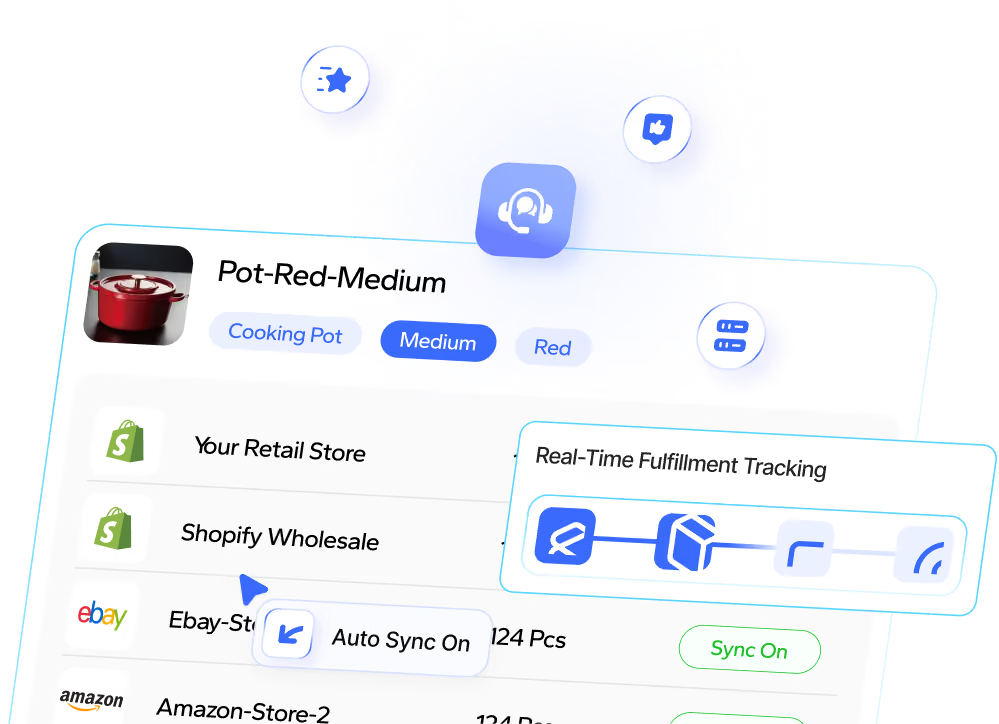
Demand forecasting works best when it is directly connected to your live inventory and sales data. Instead of managing separate spreadsheets and exporting reports from different channels, software like Sumtracker centralizes everything in one place.
.avif)
Sumtracker combines real-time inventory sync with demand-based forecasting so your projections are built on actual multi-channel sales velocity.
It tracks historical performance, calculates reorder points, factors in supplier lead times, and suggests restock quantities automatically.
Because demand forecasting is integrated with purchase order management, you can act on recommendations immediately.
You see what needs replenishment, how much to order, and when to place the order without switching tools.
For growing eCommerce brands, the benefit is clarity and control. Demand Forecasting becomes part of daily inventory operations, helping you reduce stockouts, avoid excess inventory, and plan growth with confidence.
Conclusion
Demand forecasting is not just an operational exercise. It is a growth discipline.
When you understand your sales velocity, factor in lead times, and plan with safety stock, inventory stops being a constant source of stress. Instead of reacting to stockouts or excess inventory, you make structured, forward-looking decisions.
For eCommerce brands selling across platforms like Shopify and Amazon, forecasting becomes even more important. Multi-channel growth increases complexity, and without a reliable forecasting process, that complexity turns into operational risk.
The brands that scale sustainably are not the ones that sell the most. They are the ones that plan the best.
Build a consistent forecasting process. Review it regularly. Automate it when necessary. And most importantly, treat demand forecasting as a strategic advantage, not just an inventory task.
FAQs
1. How accurate should demand forecasting be in eCommerce?
Demand forecasting does not need to be perfect to be valuable. Even improving forecast accuracy by 10 to 20 percent can significantly reduce stockouts and excess inventory. The goal is consistency and continuous improvement, not flawless prediction.
2. How often should I update my demand forecast?
High-volume or fast-moving SKUs should be reviewed weekly. Stable or slow-moving products can be reviewed monthly. The more volatile your demand or marketing activity, the more frequently you should adjust forecasts.
3. What is the difference between demand forecasting and inventory planning?
Demand forecasting predicts how much you expect to sell. Inventory planning uses that forecast to decide when to reorder, how much to purchase, and how much safety stock to maintain. Forecasting informs planning, but they are not the same thing.
4. Can small eCommerce brands benefit from demand forecasting?
Yes. Even early-stage brands benefit from basic forecasting using sales velocity and lead time calculations. You do not need advanced AI models to start. Simple moving averages and consistent review cycles can dramatically improve purchasing decisions.
5. How does multi-channel selling impact demand forecasting?
Selling across platforms like Shopify and Amazon increases forecasting complexity because each channel has different demand behavior. Consolidating data across channels is essential to avoid misallocating inventory and causing preventable stockouts.
Conclusion

Bhoomi writes about inventory management and multichannel selling at Sumtracker. Her focus is on solving real operational problems for Shopify, Amazon, and marketplace sellers through well-researched content. She covers everything from multi-location inventory syncing and stock error troubleshooting to replenishment planning and platform comparisons, turning complex eCommerce operations into clear, actionable guidance.
LinkedInRelated Articles
Tool and strategies modern teams need to help their companies grow.
![10 Best Inventory Forecasting Tools for Shopify in 2026 [Tested & Reviewed]](https://cdn.prod.website-files.com/67907f49647e48895e5dc266/6a846c0974801543b4c0ce66_Growth%20Unlocked%20with%20Sumtracker%20(46).avif)

Ready to Simplify Your Inventory Management?
Join hundreds of e-commerce merchants who rely on Sumtracker to save time, eliminate errors, and grow their business.